Sunday, November 10, 2013

Think FAST

Here's a little reminder for you for the coming holidays. Holidays, especially Thanksgiving and Christmas, are the most stressful of the year. They are also the most indulgent involving food and beverages. Did you know that alcohol consumption is greater at Thanksgiving than it is New Years Eve or St. Patrick's Day? I know, hard to believe, but true! Stress, overeating, alcohol, shoveling snow, now there is an invitation to stroke or heart attack. 

Please remember the following test shown below as you celebrate the coming holidays. You could save a loved one or even a complete stranger. Wouldn't that make your day? 

If you see any of these symptoms, don't delay. There is nothing I can stress more than: DO NOT think these symptoms will go away and you'll be fine after all, and not go to the hospital. I have heard of a couple of instances lately, one in my own family, where the person had the symptoms, then felt them go away and thought they were ok only to have them come back the next day but even worse. Remember, when there is a blockage to your brain it is estimated that 1.6 million brain cells are dying each minute. 

I think, in some cases, the person is afraid of the medical bill if the symptoms aren't really a stroke and insurance won't cover the expenses. Please don't take that chance. If you see these symptoms, you're having a stroke. Get to the hospital. I don't want to hear of you lying in a hospital bed unable to talk or move and you thinking, "Well, at least I saved $1,000 by not going in yesterday."

To Identify Stroke Symptoms 


Remember This Simple Lifesaving Test


F.A.S.T. 


[F] Face          - Ask the person to smile. 
                   
                     Does one side of their face droop?"

[A] Arms       - Ask the person to raise both arms.

                     Does one arm drift downward?"

[S] Speech  - Ask the person to repeat a
                     simple phrase.

                     Is their speech slurred or sound 
                     strange? Do they have trouble
                     understanding you?

[T] Time        - Call 911 immediately. 

                     Brain cells are dying quickly. It is
                     estimated that 1.6 million brain
                     cells die every minute after blood
                     flow is cut off.
   

Sunday, November 3, 2013

We Need a $15,000 Office Makeover

If you are on Facebook you most likely know about this already. For those of you who are not, here's what we have a chance to qualify for, and you can help us by doing two simple clicks.

Now in its 8th year, the Make My Non-Profit Run Better contest offers non-profit organizations the chance to win an office makeover that will help them run better. The Make My Non-Profit Run Better contest is organized by RK Dixon.

Click on the below icon and vote for Retreat & Refresh Stroke Camp by clicking the VOTE box located next to our name. We are listed at the bottom of the Blue Zone:


You can vote once every day until Nov 8th 5pm from any internet connected device and you can vote each day from as many different devices as you have access to. For instance, if you have an iPad, a desktop computer and a laptop computer you can vote from each one once a day. That give us a total vote count from you of 3. How great is that?

The top winning organization will receive an office technology makeover valued at up to $15,000. The first runner-up will receive a multi-function printer selected by RK Dixon and Premier valued at up to $10,000. The three remaining winners will receive a multi-function printer selected by RK Dixon and Premier valued at up to $5,000. In addition, we will award 10 runners up with printers valued at up to $1,000 each.

There is no purchase necessary to enter or participate. This contest is their way of thanking our organization for the work we and you do in the community.

We have already obtained enough votes to make it to the final round. There are now 25 finalists left in the contest and we are one of them. The 25 finalists will be narrowed down to 5 by Nov. 8, 2013 through this second round of online voting. The second round of online voting is taking place Nov. 1 at 8 a.m. – Nov. 8, 2013 at 5 p.m. RK Dixon and Premier will select a winner from those five finalists and announce the name of the winning organization on Nov. 20, 2013.

Prize: RK Dixon and Premier will assess the needs of the winning organization and then provide an office makeover valued at up to $15,000.The top winning organization will receive an office technology makeover valued at up to $15,000. The first runner-up will receive a multi-function printer selected by RK Dixon and Premier valued at up to $10,000. The three remaining winners will receive a multi-function printer selected by RK Dixon and Premier valued at up to $5,000. In addition, we will award 10 printers each valued at up to $1,000. No more than 25 percent of the $15,000 makeover may be allocated towards IT solutions.

Please help us and THANK YOU for your help.

Sunday, October 27, 2013

Our Camp Honored By The National Stroke Association As...

Outstanding Group 2013
Retreat & Refresh Stroke Camp


The Raising Awareness in Stroke Excellence (RAISE) Awards is a national awards program that annually recognizes individuals and groups for taking stroke awareness activities to new heights. This year they received over 200 nominations—the most entries to date. All these candidates represented wonderful happenings occurring across the country to increase stroke awareness.


The camp began with a vision of Marylee Nunley's, who was affected by stroke when her husband John became a stroke survivor in 2001. Recognizing that stroke affects not just the survivors but also those around them, Retreat & Refresh Stroke Camps provide a camping experience for stroke survivors and their caregivers. The camps take place at different locations throughout the U.S. including a cruise! Over a three- or four-day weekend, participants benefit from relaxation, educational programs, socialization and ongoing support— making new friends and enjoying new opportunities. What began as a one-time event in 2004, has grown to almost 20 camps nationwide. Since its beginning, they have served over 2,000 participants. 
**************************************************************************************
It's great to know that we have attained national recognition for our efforts. Wouldn't it be great to win this again next year? We can with your help. If you would like to join us by volunteering to help at a camp or you know someone who might be interested please give us a call at: 
Toll Free: 866-688-5450; or 
Peoria, Il. local: 309-688-5450. 

If you would like to see what goes on at our camps and to learn what kind of help we need, look at the top right of your screen under the heading "See What Goes On At Camp" and see what happens each day during camp.
**************************************************************************************

Sunday, October 20, 2013

Strokes affect our feline family members too

More from Monica Vest Wheeler. She has given me permission to reproduce it here on this blog. Monica's blog is titled "Turning empathy into action" and can be reached using this link:  http://monicavestwheeler.blogspot.com/  


She mostly writes about many different types of brain injuries and diseases, such as Alzheimer's, and occasionally writes one about stroke. She has published numerous books. According to her blog heading, Monica "...explores how we can lift ourselves and others by turning empathy into action … and the importance of the art of compassion in dealing with Alzheimer's, stroke, brain injuries and other life challenges." Monica is best known for her work on the Help ME Cope & Survive book series: http://www.monicavestwheeler.com/

Monica is also a very active volunteer for Retreat & Refresh Stroke Camp and arguably our best camp photographer. 

I hope you enjoy her writing and visit her blog. And be sure to browse her archived articles, too.
-------------------------------------------------------------------------

by Monica Vest Wheeler

After I poured the food into the bowl at 4 a.m. last Friday, I quickly stepped back, expecting to be bowled over by our cat, Clark, who could hear one morsel of food hitting ceramic from the far corners of our house and come running. I had learned the routine well after nearly 14 years.

I didn't hear the thundering of his paws. Instead, his sister, Lois, savored the rare opportunity to dine first and quietly as the proper little lady she was. Hmm … I walked into the living room where I saw Clark in his basket located near the front door to satisfy his insatiable curiosity on who was coming in and out. He looked up at me as he always did.

"What's wrong, Clark Bar?" He always responded to the name we had jokingly bestowed on him years earlier in homage to the candy. He was also our "spotted cow," with eight random black spots on a sea of white fur. It was then that I remembered hardly seeing him outside of his basket on Thursday as I had been rushing in and out to attend to the needs of my dad-in-law, Pepaw, whose Alzheimer's was a little scarier each day.

He protested as I lifted him out of his basket, but that wasn't unusual because he never was a holdable cat. I set him on the floor where he slowly walked forward. I studied him and noticed he was dragging his back legs or attempting to use them properly, but they weren't cooperating as they kept slipping. I carried him to his litter box in case he needed to go. He apparently didn't. He pulled himself out and started to scoot back to the living room, bypassing the food bowl.

I quickly left a phone message for the vet's office to call me first thing when they opened in another three or so hours. I then returned to the living room where Clark laid on his side on the floor. I sat down next to him and petted him. He didn't protest when I returned him gently to his basket.

I wondered … could it be a stroke?

I had certainly learned a lot about stroke in the couple years that I have been working on a book about coping with this leading adult disability. Yes, all the challenges that human survivors and their caregivers face, but could stroke have affected my feline baby, too?

The vet's staff called about 7, and I could get Clark in at 8. When I picked him up and set him in his traditional cardboard travel box, he looked around at the world with his usual curiosity during the five minute drive. I waited patiently as the vet took him out of the examining room to look at him closer.

When the vet returned, I could see it his face. Clark had "thrown" a clot and experienced something like a stroke affecting the back half of his body. I admitted that I had suspected the cause, and he nodded. I started to cry because I knew what was going to happen. I told the doctor how I had to go this day to look for the next phase of housing for my dad-in-law with Alzheimer's. And now my baby didn't have a good prognosis. His age, weight and numerous other factors were working against him as the vet gently explained the limited care options.

My heart and mind chose the right one. Keep him comfortable, I told the vet and his assistant as I needed to call my husband and son to visit our Clark Bar for the last time. I would return that afternoon to be there with him to release him from his pain.

Somehow my family understood me on the phone between my tears and loss of voice as I explained it was the best thing for our baby. They would each go to see him in the next few hours.

And then my sister-in-law and I went to look at facilities that could care for her dad's future needs. It wasn't easy or pretty to see what Alzheimer's had in store for Pepaw. Oh Lord, what a depressing day!

Late in the afternoon, my sister-in-law accompanied me as I said good-bye to my baby, Clark "Superman" Kent Wheeler. Free of the cage, he looked around the room and nuzzled noses with me and attempted to stand, but his back legs wouldn't cooperate. The vet told us that some symptoms had worsened during the day. We had made the right decision.

All of us laughed as I recounted the day when Clark became famous around the veterinary clinic as the "bat cat." About 11 years earlier, Clark had captured a bat that had gotten into our upstairs. When I discovered what the commotion was all about, Clark had the bat in his mouth and was shaking his head back and forth, beating that bat against the floor with each blow. I managed to get him to drop the bat, which I somehow bagged while freaking out at the same time.

Off to the vet we immediately went, the bat in a paper bag and Clark in his cage. They had to keep him until the bat could be tested for rabies. I wanted that to be done quickly, so the next day, I drove the bat head in a box to the testing center 45 minutes away so that Clark could be cleared to come back home sooner. No rabies, thank God! He was welcomed home as a hero for saving us from that bat!

But this day was the end of the earthly road for our hero Clark. I kissed him good-bye as he relaxed in eternal sleep. He was now free to run without pain and do all the things our beloved feline friends love in a special place in heaven.

Purr, baby, purr.

Written by Monica Vest Wheeler

Monica Vest Wheeler www.alzhelpbook.com
Blog http://monicavestwheeler.blogspot.com/
Turning Empathy into Action
Find me now on Facebook
And on Twitter http://twitter.com/alzheimersbook
Phone 1-309-682-8851
Phone toll-free 1-877-267-4640
Fax toll-free 1-877-636-0634
info@copeandsurvive.com
P.O. Box 276
Peoria, IL 61650-0276

Sunday, October 13, 2013

Survivor Story - High School Senior McKenna Stec

The following story was taken from the Nebraska State Stroke Association web site (www.nebraskastroke.org). While at the Lincoln stroke camp August 2013 I met Marcia Matthies, Outreach Coordinator for the Nebraska State Stroke Association. I first met her in 2011 at the same camp location. She gave me permission to reproduce on our blog any article they have on their site. Thank you Marcia. 

My name is McKenna Stec and I am a senior at Elkhorn South High School. 


I had a stroke before I was born so I had to figure out how to use my hand so it would be helpful in my life.  Walking was another challenge due to the stroke.  One thing that I remember since I was a baby, was wearing leg braces and hand braces. When I was six I had surgery done on my hand so it could be flexible and more useful.  One of the reasons I remember it is because the surgery was done on Halloween, I told everyone at school that I was going to be a patient for Halloween. The next day after the surgery,  my older sister Tori came in dressed up as a doctor. It completely brightened my day and she was my favorite doctor who took care of me.

Two years later I had to have another surgery, except this time it was on my foot.  When I walked, my foot would turn outward. In the hospital my dad stayed with me the whole time. I remember wanting to watch the movie Charlotte’s Web, but they couldn’t find it, so I decided to watch Mary Poppins.  It was in the middle of the night and dad was confused, he didn’t understand why I wanted to watch Mary Poppins. I remember thinking he was looking at me like I was crazy.  Every time Mary Poppins is on I remember that night.

I also recall after both surgeries life got easier, but it took time. Things such as opening marker tops and just figuring out how to do things one handed, like carrying groceries into the house or lifting boxes got better with time.  I learned that when hanging things up I had to put the hanger on my left arm to hold it still so I could hang the shirt on the hanger.  I have always had Occupational and Physical therapis’s who have helped me throughout and made sure both my hand and foot were flexible and working.  Even with all their help, I figured out a lot of strategies on my own just from my own experience and I’m still working. 

Therapy for my arm was more challenging compared to therapy for my foot.   One of the stretches I remember the most was for my arm.  My therapist Jenny held my wrist and I would have to flex it up and down.  Another activity that Jenny and I did was to practice bowling, but I had to use both hands.  I would do that with plastic cones and a plastic bowling ball and remember that it felt weird using both my hands. My favorite exercise though was going to the grocery store and pushing the cart making sure both hands were on the cart and I had to look straight ahead.  That is something that I still do to this day. 

My foot therapy made me focus and was challenging because of my balance.  I had to stand on a round surface that kept on moving.  I wanted to keep the pressure on my right foot but needed to concentrate on putting pressure on my left foot instead.  I had to focus straight ahead to keep my balance while the surface would move and almost tip me over.  I would start off with holding my therapist, Christy’s hand and then as I started to focus on a point straight ahead I would let go of her hand for as long as possible trying not to tip over and fall.    I still need to remember to pick up my foot while I look straight ahead.   I will drag my foot when I get tired and can still lose my focus.   I use a leg brace when needed so my foot won’t turn when I am walking long distances. 

My school memories begin when I was in kindergarten. I remember when I got to go on a class field trip to a farm and ride a horse in third grade.  Shortly after that I started hippo therapy which allowed me to ride horses. I was so excited!   I met new people and we had a float in the Nebraskaland Days Parade. Hippo therapy was fun because I did activities while riding that helped me keep my balance and stay flexible - things like throwing a big orange ball to Linda while on the back of Fancy or Whiskers, the two horses I rode.  We also would go and get the newspaper from the mailbox or put rings on a cone.  Fancy and Whiskers were great to ride while working on reaching and stretching.  

In 5th grade my family and I moved to Kentucky. It was hard at first since I was older and I didn’t know how people would react to me.  I started to make friends and most of them didn’t ask what happened to my hand, but some did.  They would ask things like, “Are you ok,”? Because they would think I was walking funny. I would say, “Yea, I’m fine,” and eventually mention to them that I had a stroke.    As I got to know people and gained trust I would explain to them what had happened to me. They asked thousands of questions but the main question was always, “can you move your fingers?”   This question was frustrating to answer all the time, but I would do my best to answer so they would know that I didn’t get hurt.

Some time later I started volunteering at a YMCA in the Childwatch Daycare area.  I liked it because it was fun and was a way to get out of the house for a few hours.   After I volunteered there the first two years it turned into a job by my freshman year of high school. The job was challenging, but I was able to do it well with some different strategies that I figured out on my own.   I remember when I was in 7th grade a teacher told the class how people can be different.  She said “…like McKenna, she looks like she needs help because of her hand, but really she has it under control.”  She told the class, “Unless she comes up to you or asks for help, she has it taken care of.”  So, I like to experience things on my own and if I can’t come up with a strategy then I will ask for help. 

Along the way I got involved with high school bowling.  I have been doing it since the 8th grade. I am on the high school bowling team and qualified for individual state championship competition both my junior and senior year.  I am looking forward to participating in bowling for Special Olympics. 

My plan for the future is to graduate from high school in 2013 and go to Metro Community College and learn how to be an administrative assistant.  I hope to become an OT/PT assistant one day in the future because of all my experience. 
I am looking forward to the future and I will never give up! 
*********************************************************************************************

Sunday, October 6, 2013

What Do You Remember About Your Stroke

The following story was taken from the Nebraska State Stroke Association web site (www.nebraskastroke.org). While at the Lincoln stroke camp August 2013 I met Marcia Matthies, Outreach Coordinator for the Nebraska State Stroke Association. I first met her in 2011 at the same camp location. She gave me permission to reproduce on our blog any article they have on their site. Thank you Marcia. 

Keith Fickenscher Stroke Story

WHAT DO YOU REMEMBER ABOUT YOUR STROKE FROM
BEGINNING UNTIL NOW?


On Thursday, May 31, 2012 I had an appointment with a pulmonologist to determine why I was coughing up dark blood every morning. He ordered a CT scan which revealed what he thought was a pulmonary embolism in my left lung and an “unidentified mass” in my right lung. I was hospitalized and he ordered Coumadin and Lovenox to dissolve the PE. Friday night I had a relatively short episode of coughing up bright, red blood, which didn’t seem to be concerning, so the drugs were continued. Saturday night I experienced massive and sustained bleeding from one of my lungs.

I truly believed I would die. A CT scan revealed the bleeding was from the mass in my right lung. There was now no evidence of a pulmonary embolism in my left lung. The Pulmonologist tried twice to sample the mass which was in the lower right lobe, but the airway was blocked with sticky, clotted blood. So the decision was made to remove the mass surgically by removing the lower lobe. When I woke up in the ICU, the surgeon told me I was “very lucky” because the mass was “accumulated pneumonia” and there
“wasn’t a cancer cell in it.”

I went back to sleep in the Cardiac ICU in Bryan East following my
successful lung surgery (thoracotomy involving a wedge dissection of lower lobe of right lung). It was around 11:00 p.m. when a nurse woke me and asked me to brush my teeth. I could not reach the toothbrush on my overbed table. 
It seemed like the nurse was moving the table away from me. I asked her to put the brush in my left hand. She did and I could not control my left arm. When I extended it, the arm “floated” back and forth in a wide arc. I then became aware that the slurred speech I heard in the room was me. I told the nurse I thought I was having a stroke and she agreed. 

This is the second time I thought I might die. She called in the “BERT” Team and they confirmed our suspicions. They sent me for a CT scan and when I returned to ICU, my Thoracic Surgeon and a Neurologist were there. I asked for the clot buster shot but the neurologist said the CT scan did not show the clot. It was gone. He also said the shot would cause fatal internal bleeding related to my surgery that afternoon and he would not give me the
shot.

I expressed concern that the epidural I had opted for prior to surgery had caused the stroke. Suddenly the anesthesiologist appeared in my room and he informed me he had been administering epidurals for “30 years and an epidural had never caused a stroke.” The Thoracic Surgeon assured me he did nothing that would have caused the stroke. Prior to the surgery, they had doplared my legs and carotid arteries and performed an echo-gram of my heart. They saw no evidence of clots. The origin of the clot that caused my stroke remains unknown.


HOW LONG WERE YOU IN REHAB?

On Friday of the week following admission, I was transferred to Madonna for acute inpatient rehab. My anticipated discharge date was set for August9, which seemed like an eternity away! 

I made steady progress in rehab, going from where it took four people to help me take a single step to where I could walk 250 feet with a cane and 1 assist. I went from requiring a Vander-Lift to get me in and out of bed, to transferring to my wheelchair myself and toileting myself and showering myself.

Then one week before my scheduled discharge, I awoke with a severe pain in my chest. My blood pressure had dropped to 50/60. After a full day with no improvement I returned to the hospital where a CT scan revealed a suture in my chest wall ruptured and dumped 2700cc of blood into my right chest cavity.

This was the third time I thought I would die. Back to the hospital for a week to stop the bleeding, then three more weeks of inpatient rehab. I will never forget when I returned to my room at the rehab facility, an Aide removed the sign from above my bed that said I could transfer myself. She said, “This won’t apply now.” I was crushed.

I was dismissed from inpatient rehab on August 29 and went back to work full time on September 12, which was the 90th day after my stroke and my 65th birthday.

About a month later, on October 16th while sitting at my desk at 8:00 a.m., I had a stroke related seizure. I had no warning whatsoever. I woke up in the CT scanner with no idea how I had gotten there. This was the fourth time I realized how fragile life really is. Another week in the hospital and two weeks of skilled inpatient rehab at Lancaster Manor, after which I again returned to work full-time as Administrator of Lancaster Manor. I have
learned a hard lesson in how fast one’s world can turn upside down. After more than six decades of bullet proof health, my health is now my foremost challenge.


WHAT WERE YOUR BIGGEST SUPRISES WITH YOUR STROKE
EXPERIENCE?


My biggest surprise has been how a stroke affects every single aspect of your life. A stroke is a hurdle between you and anything you want to do. I was surprised by how much I detested pureed food and honey thickened liquid.

WHAT WERE YOUR BIGGEST CONCERNS OR FEARS RELATED
TO YOUR STROKE EXPERIENCE?


My fears include having another seizure while I am driving … or having another stroke that affects my right (“good”) side. I also worry about falling, whether I will regain use of my left arm, and whether I will ever be able to walk without assistance. I also worry about the added burden my stroke has had on my wife. Prior to my stroke, I was left-handed. I have been surprised to learn how hard right-handed people struggle to do all the things that come easily for lefties!

ADDITIONAL COMMENTS:
I learned a lot as a resident of nursing homes and a hospital for five months. I learned there are four essentials to giving patients quality of life.

1. Good food … made from scratch by people who take pride in their work and who strive to “raise the bar.”

2. Engaging activities … especially on weekends.

3. Dedicated Rehab Therapists with excellent therapy equipment at their disposal.

4. A staff of direct caregivers and support people who understand how important they are to the residents in their building.

My new mission in life is to teach those four essentials to my colleagues in Nebraska’s nursing homes. My stroke stripped me of everything but life itself … so I am going to dedicate the rest of my life to advocate for quality in the lives of residents in Nebraska’s nursing homes, assisted living facilities and rehab hospitals.
******************************************************

Sunday, September 29, 2013

"I didn't sign up for this"


Another fine article written by Monica Vest Wheeler, and originally posted on her blog. She has given me permission to reproduce it here on this blog. Monica's blog is titled "Turning empathy into action" and can be reached using this link:  http://monicavestwheeler.blogspot.com/  

She mostly writes about many different types of brain injuries and diseases, such as Alzheimer's, and occasionally writes one about stroke. She has published numerous books. According to her blog heading, Monica "...explores how we can lift ourselves and others by turning empathy into action … and the importance of the art of compassion in dealing with Alzheimer's, stroke, brain injuries and other life challenges." Monica is best known for her work on the Help ME Cope & Survive book series: http://www.monicavestwheeler.com/

Monica is also a very active volunteer for Retreat & Refresh Stroke Camp and arguably our best camp photographer. 

I hope you enjoy her writing and visit her blog. And be sure to browse her archived articles, too.
--------------------------------------------------------------------


by Monica Vest Wheeler

During four years of immersing myself in the topic of dementia and Alzheimer's, and writing and speaking about it, plus now serving as a caregiver, I've heard just about every scenario, crisis and triumph.

But there's one caregiver statement that really hits me now and then:

"I didn't sign up for this."

I was thinking about that one Sunday as I sweated in the July heat and watched my dad-in-law, Pepaw, fish. No, I didn't specifically sign up for this chore when I agreed to be his caregiver. I think it was in the fine print under "and all other duties as assigned."

There are a lot of things in life that I didn't sign up for. The first one that comes to mind is life itself. Nope, don't remember signing on any dotted line for this adventure, but I arrived and have tried to make the best of it.

I didn't sign up for my mom and dad, grandparents, aunts, uncles, cousins, etc. I got to know and love them and created my own place in the family. I learned to adjust and weave my way through a complex world that made no sense to a little girl.

I certainly didn't sign up for measles, chicken pox, bad tonsils, cuts that required stitches, and broken toes. If I had had any say, I would have requested summer weather year-round as a child so I could play outside every day.

I don't recall adding to my "want-to-do" list things like going to school, doing homework, being made fun of, fighting with so-called friends, and doing household chores. Those were the kind of things that came with this job of life.

I didn't sign up for rejection when the boy I had fallen for didn't like me in the same way in junior high, though he was quite amused by my lengthy and chatty letters. I didn't seek disappointment when I was not selected as a junior high drum major or my writing contest entries didn't win.

I did sign up for love when I met the right man and got married. However, I didn't sign up for arguments, financial headaches and the really hard work it takes to make a marriage work. But I've accepted those challenges along the way because I love this man.

I did sign up for motherhood when I gave birth to a robust boy. However, I must have missed all the fine print on the hours it demanded. Nowhere had I signed my name that I wanted to have more sleepless than restful nights those first couple of years. And I would have never agreed to chain myself to the pile of laundry a growing boy creates. But I waded through it and survived because I love my baby boy who's become a wonderful man.

I didn't sign up for the tragedy of war, high taxes, inept government and elected officials, potholes, road construction, mandatory insurance, and standing in line forever. I would have definitely voted down whoever created and implemented the phrase, "Life isn't fair."

I didn't sign up to be at my grandpa's side when he passed away, but I was there when it happened. I didn't sign up to attend the funerals of friends who died tragically, but I went to express my sympathy to their loved ones who had never asked for that kind of grief. I never signed up to lose my mom-in-law 10 years ago or my dear friend this year. I would have ripped and burned any paper that asked for my signature. I had signed up for love, but somebody made the rule that sometimes we lose the people we love. However, I wouldn't have missed the love for anything because the love really does last longer than the grief.

This spring, I signed up to be a caregiver for my father-in-law even though I knew Alzheimer's was slowly stealing his life. I didn't ask for the anger, accusations, threats and rudeness of recent weeks. I was not eagerly looking forward to having to help clean him when he soils himself, saving bushes from catching on fire when he flips his cigarettes into them, or having to hurry to his assisted living facility when they call about his erratic behavior.

I never asked for a broken heart, exhaustion, tears of frustration, loss of freedom and countless hours to do what I want to do, and being told, "You don't love me."

If caregivers saw every single thing that they'd have to do in caring for a loved with Alzheimer's or any catastrophic illness or injury, there would be few takers. Who asks for heartache, anger, pain and grief? I didn't, but I accept it because it's part of a higher calling and purpose in life, to show compassion to those we love … and to pray someone will show that same compassion when we need it in our final days.

No, I didn't sign up for "this," but no one is going to erase me now.

Written by Monica Vest Wheeler

Monica Vest Wheeler www.alzhelpbook.com
Blog http://monicavestwheeler.blogspot.com/
Turning Empathy into Action
Find me now on Facebook
And on Twitter http://twitter.com/alzheimersbook
Phone 1-309-682-8851
Phone toll-free 1-877-267-4640
Fax toll-free 1-877-636-0634
info@copeandsurvive.com
P.O. Box 276
Peoria, IL 61650-0276

Sunday, September 22, 2013

Wisconsin Retreat and Refresh Stroke Camp Weekend

by Sarah Christy

Hi, all,
We are very excited to be bringing the Retreat and Refresh Stroke Camp weekend to Wisconsin. A big THANK YOU to the organizers and champions of this event. I haven't been to Green Lakes Conference Center. The pictures on the website are awesome and looks like the perfect spot for a weekend of learning, growth, and fun. I hope you are ready to have a wonderful weekend volunteering with our campers, with a full camp we will all stay busy but, don't worry you will have great laughs, inspiring moments, and leave filled with great memories.

We are asking that all volunteers arrive by 11:30 on Friday morning (Oct. 4) for a lunch and volunteer orientation. Please let me know ASAP if you will not be there for lunch. During the meeting, we will review the schedule for the weekend and make some volunteer assignments. Following that, we will have a few more things to finish setting up before the campers start arriving at 2:30. If your availability for the weekend has changed since you filled out your volunteer application, please let me know that as well so we can give an accurate count for all meals and lodging.

Larry Schaer, Boyd Christy, and I will be directing camp. Deb Rossman and Cindy Barth will be running crafts, Chuck Jones will be our administrative/photography person, and Deb Shaw will be assisting wherever needed. Kyle & Lindsey Wilhelm will be our music therapists for the weekend.

Please let me know if you have any questions. Can't wait to meet you all!

Sarah Christy, Operations and Programming Coordinator for
Larry Schaer, Director
Boyd Christy, Operations


************************************************************************


I attached a few documents that Sarah sent to the volunteers and campers for you to review so you can get a feel for what our camps are all about. 

General Notes:

-Remember campers, this is your weekend. We suggest you participate in any of the activities you like or as needed, just relax on the beautiful grounds.

-Resources, games, videos, books, and educational materials are available for your use this weekend.

-Meals are served promptly at listed meal times.

-Please keep track of children throughout the weekend.

-Camp quiet time is 10:00 pm to 7:00 am.

-Alcohol is forbidden at Green Lake Conference Center and there is no smoking allowed in any of the rooms or buildings on the grounds.

-Pets are not allowed at Green Lake Conference Center.

-Depending on your cell phone service provider, cell service may be spotty throughout the grounds.

-There is free WiFi in the Dining Hall and in the lobby of the building where we will be sleeping.

-There are no tv’s in the sleeping rooms; however, there are alarm clock radios.

-Pampering is available on Saturday, following the morning educational sessions. First come, first serve.

-Volunteers are here to serve you and make it an enjoyable and relaxing weekend, please do not hesitate to ask them if you need any assistance.

-There may be some last minute schedule changes.

-We will have the opportunity to fish and go for pontoon boat rides on Saturday. Bring your own fishing poles if you like, otherwise some will be provided. We have a temporary day fishing license that the stroke survivors can use to fish, and we will also have bait available. If you have your own fishing license, please bring it with you.

-As part of our “Meet Me at the Fair” weekend, we will be having a Grand Stand Show on Saturday night. If you have a special talent, joke, song, etc… that you would like to share with others, please come ready to perform!

-In case of emergency, no matter how small see any volunteer or use the phone to dial 911.

-Weekend Schedule-our itinerary for the weekend. 
The schedule is always subject to change, but that we do our best to adhere to it. Saturday afternoon will be especially busy with multiple offerings from which people can choose. We will have pontoon boat rides, fishing, a tram tour, scenic walks, crafts, indoor/outdoor games, golf cart rides, and more! We will need volunteers to help with each of these things (we will assign at camp). In addition, we will spend some time Saturdayafternoon setting up for the Carnival/Grand Stand Show that will be Saturday evening.

Meet Me at the Fair

Friday, October 4
2:30-4:00 p.m.          Registration, room assignment, refreshments, crafts
4:00-4:30 p.m.          Get acquainted drum circle
4:30-5:30 p.m.          Survivor and caregiver get acquainted break out groups
5:45 p.m.                   Dinner
7:00 p.m.                   Team poster making and team games
7:45 p.m.                   “State Fair” the movie, campfire, informal discussion, games, crafts, resource table, free time, etc…
9:45 p.m.                   Brief volunteer meeting
10:00 p.m.                 Camp quiet time
Saturday, October 5
7:00 a.m.                   Wake up
8:00 a.m.                   Breakfast
9:00 a.m.                   Coping Skills for Your New World, co-presented by campers Eric Sarno & Tracy Nelson           
10:00-12:00 p.m.     Experiential options: pampering (massages, Mary Kay facials, manicures, paraffin dip), fishing, Wii, crafts, golf cart rides around the grounds, outdoor games, tai chi experience with Seth, pharmacist, etc…  
12:00 p.m.                 Lunch
1:00 p.m.                   All camp photo
1:15 p.m.                   Brief volunteer meeting
1:15-4:30 p.m.          Rest/Free time: crafts, fishing, pontoon boat rides, Memory Lane walk (reflective walk) chair yoga video, games, Wii, golf carts rides around the grounds, etc…
2:30 p.m.                   Tram tour
4:00 p.m.                   Optional snack preparation demonstration
4:30-5:30 p.m.          Caregiver and Survivor break out groups
5:45 p.m.                   Dinner
7:00 p.m.                   Carnival games followed by Grand Stand Show
8:30 p.m.                   Free time: relax and chat, games, bingo, resource table, etc…
10:00 p.m.                 Camp quiet time
Sunday, October 6
7:00 a.m.                   Wake up
8:00 a.m.                   Breakfast                   
9:00-9:45 a.m.          Packing/Free time
9:45-10:30 a.m.        Worship service
10:30-11:15 a.m.     All camper competition
11:15-11:45 a.m.     Drum circle-celebration of the weekend
12:00 p.m.                 Lunch
1:00 p.m.                   Evaluation, photo and address distribution, good-byes, safe travels


-What to Bring to Camp

-Please note that there are no hair dryers in the rooms. Be sure to bring your own if you need it. If you have a few fishing poles, it would be very helpful if you would bring them as well. 

Bedding & Linens

Linens and towels are provided in all rooms. Rooms are hotel style with a private bathroom in each room. Handicapped rooms will be assigned based on greatest need.

Toiletries

Bring your own soap, shampoo, razors, lotion, personal grooming items (combs, brushes, hair spray, deodorant, toothbrush, toothpaste, etc.), etc… There are no hair dryers in the rooms, so be sure to bring your own if you will need it.

Medication

Bring all your medications (as listed on your health form) both prescription and non-prescription. The camp nurse will check your list upon arrival. Campers will be responsible for dispensing of their own medications unless monitoring is requested by the camp nurse. A refrigerator will be available for medications that need refrigerated.

Meals

Meals will be served buffet style in the dining hall. There is a salad bar at lunch and dinner. Each meal with have a couple of entrees from which you can choose. Volunteers will be happy to assist survivors through the buffet line. If you listed a special diet request on your registration form, this information has been relayed to the chef. They have asked that you please identify yourself to the buffet attendants when you go through the line and the attendant will let you know what foods are safe for you to eat.

Clothing

Bring casual comfortable clothing adequate for Wisconsin weather in early October. Be sure to bring comfortable walking shoes if you plan to tour the grounds. It is suggested that you bring rain gear in case of rain.

Miscellaneous

You can bring small items for comfort in your room. There are no TV’s in the rooms, but there are alarm clock radios. Typically campers aren’t in their room much except for sleeping, but please feel free to make yourself comfortable.

Equipment

If you have equipment or games you’d like to bring for your use or to share, please feel free to bring it along. We will have a chance to fish on Saturday, if you have your own fishing pole and would like to bring it, please do so. We have a temporary fishing license that the stroke survivors can use to fish with on Saturday, but if you have your own fishing license, please bring it. Please bring any adaptive equipment that is necessary for you to complete your activities of daily living.

Odds and Ends

Fly swatter, bug spray, sun screen, umbrella, flashlight, etc.

                                *****************
This year’s theme is Meet Me at the Fair. It will be a state fair/midway theme. We will have camp shirts for everyone. We hope it will be a fun and relaxing weekend for all! We look forward to meeting you!

Here is a detailed overview of the offerings that will be available for Saturday night of camp. It may be helpful for you to review them prior to your volunteer experience at camp. Thank you.

Evening Entertainment—The evening begins with folks entering the midway and receive their tickets to play the games and work the midway. Give each camper about 10 tickets, or so. The tickets are used for all the midway stations.

Along the Midway-Below are the games and activities that we will have. We will need volunteers to help at these midway stations as well as participate in the Grand Stand Show.

Lemon Shake Ups: For a ticket, campers and volunteers receive a lemonade drink in a souvenir cup. Cut lemon wedges and put in bottom of cups with ice. Some cups can be filled just before the campers arrive.

Cotton Candy—There is a cotton candy machine and sugar for use in making cotton candy. Whoever is doing this will want to try, just a little to get the feel for it. It is available for one ticket. Needs to be soaked and washed before packing away.

Plinko—Drop three chips and see your score

Sno-Cones—Sno Cone Machine is available to crush ice, scoop into cups and add syrup. Need soap and water for clean up. Cost for sno cone is one ticket.

Milk Bottle Toss—This is set up inside the box that contains the bottles and balls. Each person gets two balls for one ticket and tries to get all three bottles knocked down with the two balls. Prize awarded

Pick a Duck—Fill pool with enough water for the ducks to float. For one ticket, the person picks two ducks, add the numbers and award a prize accordingly.

Fish Bowl Toss—For one ticket, a person gets three ping pong balls to toss and see if they can “catch” a fish. Prize awarded accordingly. The fish bowls should sit inside a plastic crate on it’s side to keep balls from going all around the room.

Ring Toss—For one ticket, person gets rings to toss over the bottles. Score and award prizes accordingly.

Fortune Teller—Person sits down with the fortune teller and gets their fortune told. No prizes awarded, the fortune is their prize. We have sample fortunes.
******************************************************

Sunday, September 15, 2013

Gluten-Free Labeling Consumers Can Count On

by Chuck Jones

This information was copied from the US Food and Drug administration web site. A link to their website is included at the bottom of this article.

People with celiac disease can now have confidence in the meaning of a "gluten-free" label on foods.

The Food and Drug Administration (FDA) has issued a final rule that defines what characteristics a food has to have to bear a label that proclaims it "gluten- free." The rule also holds foods labeled "without gluten," "free of gluten," and "no gluten" to the same standard.

This rule has been eagerly awaited by advocates for people with celiac disease, who face potentially life-threatening illnesses if they eat the gluten found in breads, cakes, cereals, pastas and many other foods.

As one of the criteria for using the claim "gluten-free," FDA is setting a gluten limit of less than 20 ppm (parts per million) in foods that carry this label. This is the lowest level that can be consistently detected in foods using valid scientific analytical tools. Also, most people with celiac disease can tolerate foods with very small amounts of gluten. This level is consistent with those set by other countries and international bodies that set food safety standards.

"This standard 'gluten-free' definition will eliminate uncertainty about how food producers label their products and will assure people with celiac disease that foods labeled 'gluten-free' meet a clear standard established and enforced by FDA," says Michael R. Taylor, J.D., deputy FDA commissioner for foods and veterinary medicine.

Andrea Levario, executive director of the American Celiac Disease Alliance, notes that there is no cure for celiac disease and the only way to manage the disease is dietary—not eating gluten. Without a legal definition of "gluten-free," these consumers could never really be sure if their body would tolerate a food with that label, she adds.

"This is a tool that has been desperately needed," Levario says. "It keeps food safe for this population, gives them the tools they need to manage their health, and obviously has long-term benefits for them."

"Without proper food labeling regulation, celiac patients cannot know what the words 'gluten free' mean when they see them on a food label," says Allessio Fasano, M.D., director of the Center for Celiac Research at MassGeneral Hospital for Children, visiting professor of pediatrics at Harvard Medical School and member of the American Celiac Disease Alliance.

What Is Gluten?

Gluten means the proteins that occur naturally in wheat, rye, barley, and crossbreeds of these grains.

As many as 3 million people in the United States have celiac disease. It occurs when the body's natural defense system reacts to gluten by attacking the lining of the small intestine. Without a healthy intestinal lining, the body cannot absorb the nutrients it needs. Delayed growth and nutrient deficiencies can result and may lead to conditions such as anemia (a lower than normal number of red blood cells) and osteoporosis, a disease in which bones become fragile and more likely to break. Other serious health problems may include diabetes, autoimmune thyroid disease and intestinal cancers.

Before the rule there were no federal standards or definitions for the food industry to use in labeling products "gluten-free." An estimated 5 percent of foods currently labeled "gluten-free" contain 20 ppm or more of gluten.

How Does FDA Define 'Gluten-Free'?

In addition to limiting the unavoidable presence of gluten to less than 20 ppm, FDA will allow manufacturers to label a food "gluten-free" if the food does not contain any of the following: an ingredient that is any type of wheat, rye, barley, or crossbreeds of these grains an ingredient derived from these grains and that has not been processed to remove gluten an ingredient derived from these grains and that has been processed to remove gluten, if it results in the food containing 20 or more parts per million (ppm) gluten.

Foods such as bottled spring water, fruits and vegetables, and eggs can also be labeled "gluten-free" if they inherently don't have any gluten.

The regulation will be published Aug. 5, 2013 in the Federal Register, and manufacturers have one year from the publication date to bring their labels into compliance. Taylor says he believes many foods labeled "gluten free" may be able to meet the new federal definition already. However, he adds, "We encourage the food industry to come into compliance with the rule as soon as possible."

Under the new rule, a food label that bears the claim "gluten-free," as well as the claims "free of gluten," "without gluten," and "no gluten," but fails to meet the requirements of the rule would be considered misbranded and subject to regulatory action by FDA.

Those who need to know with certainty that a food is gluten-free are heralding the arrival of this definition. "This is a huge victory for people with celiac disease," says Levario. "In fact, that's the understatement of the year."

Says Taylor, "FDA's 'gluten-free' definition will help people make food choices with confidence."

This article appears on FDA's Consumer Updates page, which features the latest on all FDA-regulated products.

August 2, 2013

For more information on gluten-free visit: http://www.fda.gov/ForConsumers/ConsumerUpdates/ucm363069.htm#gluten-free

Sunday, September 8, 2013

A Chance To Be Normal: Stroke Camp offers respite, renewal to survivors and caregivers

This year, August 16-18 2013, I helped with Retreat & Refresh Stroke Camp at the Carol Joy Holling Conference and Retreat Center in Ashland, near Lincoln, Nebraska. We were visited by Erin Andersen, news reporter, and Francis Gardler, photographer, from the Lincoln Journal Star. Following is the article Erin wrote about our camp. I have inserted some of the photos I took at this camp.


*********************************************************************************
 By ERIN ANDERSEN / Lincoln Journal Star
  
 People are always there in the beginning. To help. To talk. To laugh. To cry.

But as time passes, the visits decrease. It’s hard to find things to talk about. Your life is so different now. Nothing is the same ... and never will be.

After a stroke it’s the isolation that is hard to deal with, said Kathy Doak, whose husband, Mark Doak -- a former Nebraska football player and 1975 sixth-round draft pick of the NFL team in Washington -- suffered one in 2011.

You don’t do the things you used to do. Heck, you don’t even leave the house. It’s too much work. You’re so exhausted -- even picking up the phone to say "Hi" is overwhelming, Kathy Doak said.

So when stroke survivors and their caregivers -- typically a spouse, a child or a sibling -- are invited to attend the annual Retreat & Refresh Stroke Camp, their initial reaction is somewhere along the lines of: Are you nuts?

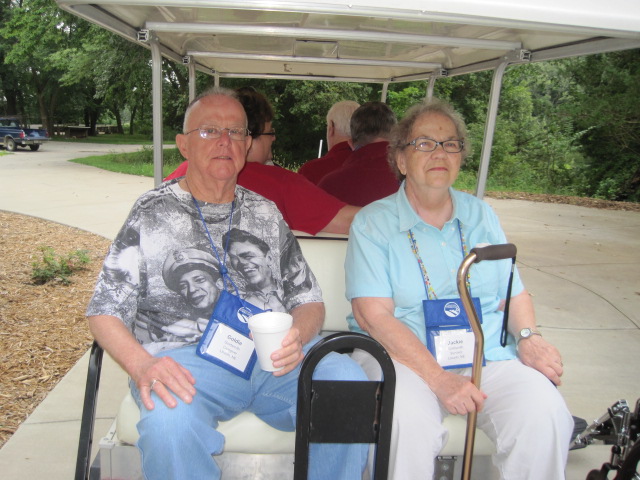
     Goldie (caregiver)                     Jackie (survivor) 

That is exactly what Goldie and Jackie Goldsmith of Lincoln were thinking when their doctors, nurses and therapists kept telling them that they “really needed to go to Stroke Camp.”

“We don’t get out and do a lot of things anymore -- because we can’t,” said Jackie, who suffered a stroke in November 2010.

“We kind of had to be talked into it (camp),” she said of their first camp experience in 2012. “Now we look forward to it every year. We meet some of the same people and meet some new people. We laugh a lot. It’s good medicine for you.”

Retreat & Refresh Stroke Camp -- as the name implies -- is a 48-hour summer camp complete with camp songs and slogans, arts and crafts, games, bonfires, fishing, canoeing and paddle boating.

“Survivors and caregivers have that perception: we can’t do this. That going to camp is like climbing Mount Everest,” camp director Larry Schaer said. “They have a perception of what they can’t do -- not what they can do.”

The camp is housed here at the Swanson Center
The Lincoln Stroke Partnership -- a collaboration among Bryan Medical Center, Saint Elizabeth Regional Medical Center and Madonna Rehabilitation Hospital -- and Retreat & Refresh Stroke Camp host the two-day event at Carol Joy Holling Conference and Retreat Center in Ashland.

This year’s camp, held Aug. 16-18, included 20 couples -- 10 stroke survivors and their caregivers -- 15 volunteers and five camp staffers.


Volunteers take care of everything, so caregivers truly have a weekend respite -- a weekend with massages, manicures, pedicures, facials and other spa-style pampering, along with campfire songs, stories and skits. A weekend where they don’t have cut their survivor’s food, help them use the bathroom, keep a watchful eye every second.
“Just to see the people and be able to enjoy normalcy and have fun with the survivor is wonderful,” Kathy Doak said.

A loving partnership turns into a full-time role of nurse, therapist, maid, cook, custodian and family CEO.


“When volunteers take over all the duties, when they take the load off the caregiver, it is just so relaxing," Kathy Doak said. "The stress reduction from that weekend is awesome.”


They have fun like they did B.S. -- Before Stroke -- before they were known as survivors and caregivers.

“Most events after stroke are not joyous," Mark Doak said. "But Stroke Camp is a celebration of life.”

***

Camp begins in a circle. In the middle are drums, tambourines and other music makers. Jenny Denk, a music therapist, gives each camper an instrument. Returnees know exactly what they want. Newcomers are wary.

But in minutes they forget to be shy, banging and shaking out beats as they introduce themselves, and call out their favorite fair food (in honor of this year’s camp theme: Meet Me at the Fair).


The ice is broken.

Survivors and caregivers divide into separate groups. Another chance to get acquainted -- this time with others living the same trials, tribulations, heartbreak and exasperation.

They share top of the mountain and bottom of the valley experiences.

Stroke survivors let go of some of the frustration, the anger, the resentment and self loathing. They hate being a burden.

“Everybody wants as close to a regular life as they had prior to the stroke,” Mark Doak said. “They want to be independent. They want to do things for themselves; not bother their spouse.”

Abilities they used to take for granted: getting a cup of coffee, making a grilled cheese sandwich, taking a shower, wiping your butt and killing the snake that slithers onto your front walkway in front of your wife and dog …

“All those things husbands just do -- now it has to be done for me,” Mark Doak said. “There has to be some anger for the caregiver. Some thought of: I didn’t sign up for this.”

Sentiments are the same for the survivor, but for different reasons.


“She is my keeper. I’m in the cage” Mark Doak said.

Kathy chokes on a laugh: “But what a nice cage it is!”

“I rattle the cage doors frequently and they never get open,” Mark said, not so subtly referring to his desire to drive again.

“I would gladly give the keys back if it was safe,” Kathy replied.

Across the hallway caregivers reluctantly put into words the tornado of emotions they have fought so hard to control -- and ignore.

It feels like you’re:

* A rubber band being stretched more and more

* A piece in a jigsaw puzzle, continually trying to figure out how it fits.

* A paper clip struggling to hold it all together all by yourself.

“A marble, ‘cuz I feel so much like I’m losing mine,” a few say.

Kathy Doak remembers her first stroke camp in 2012 and hearing the stories of returning caregivers.

“I thought: I’ll never get there. I’ll never get to the level of assurity that it will get better,” she recalled. “Everyone was so very encouraging. It was heartwarming.

One year later, Kathy Doak is now reassuring newcomers: It is OK to vent. It is good to laugh and cry, and glom on to the faith that this “new normal” can get better over time.

“Stroke camp is the ultimate release for feeling normal again,” Mark Doak said. “Stroke Camp is a safe place to break down the wall that everybody puts up and just go for it.”

* * *

Marylee and John Nunley of Peoria, Ill., held the first Retreat & Refresh Stroke Camp in 2001. The couple had always camped. Then John suffered a stroke. Marylee took care of him 24/7. A weekend off was an impossibility -- never mind the the prospect of camping again.

What if … Marylee wondered.

She hosted the first-ever camp inviting local fellow stroke survivors and their caregivers to a carefree weekend where disabilities and brain injuries were handled with such ease, it was like the old days -- Before Stroke. Where caregivers were the ones being cared for, pampered and treated like the heroes they are.

“That first camp was such a success that the next summer they held two camps, and the year after they held four camps,” Schaer said.

The camp focus is four-fold: educate, socialize, relax and support.

The 2013 camp at Carol Joy Holling Retreat Center was Lincoln’s third; and the 77th overall for Retreat & Refresh Stroke Camps held throughout the United States. All told, there will be 17 or 18 camps throughout the country this year. Next year, that number no doubt will climb to at least 20 -- odds are Lincoln will hold two camps. This year, six families were on waiting lists in case space opened up.

Stroke Camp is costly to put on, Kathy Doak said. All but a few thousand of the $20,000 price tag is funded by donations and fundraising. Stroke families are asked to pay $100 per person -- for some that is fantasy, which is why hopes are the Lincoln Stroke Partnership might raise enough money to provide camp scholarships.

***

Simply put, a stroke is a brain injury.

“A brain attack,” Kathy Doak said. “The effects are not just physical. ... Every part of your being is affected.”

“Your life and everybody else's is turned upside down,” Mark Doak added. “A stroke is forever.”

Which is why strokes are so isolating.

“There are 7 million people out there with strokes -- without having any connections and support other than family,” Schaer said. “Camp is a critical element of support for survivors.”

Bob Becker has attended all three Lincoln Stroke Camps.

He had his stroke April 1, 2010.

“A bleeder on my left side,” he said. An avid fan of television medical shows, Becker said he realized quickly the numbness and clumsiness in his right hand was a symptom of a stroke.

“Thank goodness for cell phones,” he said, noting that a freak outage had left landlines useless that day in Lincoln.

Becker called a family member: I think I’m having a stroke. When the family member started asking questions, Becker stopped him: “If you keep talking to me I might not be alive in a couple of minutes.”

An ambulance arrived a short-time later.

“By the time I got to the hospital I had slurred speech and was not able to use my right hand or leg.”

The recovery has been long and slow. But with persistence and perseverance progress is made.

“Watching people gives me hope,” Becker said, recalling the camper whose stroke left him unable to speak for five years. Last year, he got up and told a joke at camp. Fellow campers were laughing and crying at the same time.

In the 800,000 stories of stroke each year, Becker’s awareness is unique, Schaer said.

“Only 20 percent of people know the signs and symptoms of stroke," he said. “Eighty percent have no idea of the signs and the urgency of the matter.

“Only 20 percent of people having a stroke make it to the hospital within a three-hour window to receive TPA (a clot busting drug), resulting in minimal to no deficits.

“With 800,000 people a year having a stroke and with only 20 percent of that population getting to the hospital in time, that means 80 percent are losing a lifetime opportunity. Once that window of opportunity is missed, you don’t get a second chance.”

The symptoms sound straightforward:

* Sudden numbness or weakness in the face, arm or leg, especially on one side.

* Sudden confusion, trouble speaking or understanding.

* Sudden trouble seeing in one or both eyes

* Sudden trouble walking, dizziness, loss of balance or coordination.

But most people ignore the symptoms -- reasoning they are tired, stressed or getting sick. Many take an aspirin and a nap hoping it will just go away, Schaer said.

And if they are having a mini-stroke, a TIA (Transient Ischemic Attack), it will go away as suddenly as it appeared. But it will come back -- with a vengeance. Up to 40 percent of all people who experience a TIA will go on to have an actual stroke in the next 12 months. Nearly half, will have a stroke within two days of a TIA.

“Lack of understanding is a major issue. If we could fix that, hundreds of thousands of people could have minimal effects,” Schaer said.

Chuck Jones, administrative assistant at Stroke Camp, lost a cousin three weeks ago to stroke.

It started with a mini-stroke. Her words suddenly became garbled. Well-meaning friends told her to relax. She did. Her speech returned to normal. The next day she had a terrible headache. She took aspirin and a nap, and declared upon waking that she never felt better, Jones said.

“The third day she suffered a massive stroke and died that night.”

* * *

Stories of delay and denial are the bane of stroke survivors and families.

Nearly every survivor will tell you that whether they knew what was happening or weren’t quite sure -- they all held on to the belief it could not happen to them.

And sometimes stroke symptoms are not all that obvious -- at least not enough to feel like you need to head to the emergency room.

Jackie Goldsmith says hers began with her leg. Her husband noticed she was walking funny. Over the next two days, she relied on the strong stable arm of her grandson as she shopped.

“I was still walking, but it was like I was drunk or drugged or something,” Jackie recalled.

Her husband suggested they call the doctor. He ordered an MRI. Physically she was reeling a bit as she attempted to walk out of the medical center. They sent her straight to the hospital.

“After that I couldn’t stand,” Jackie recalled.

Lincoln’s Larry and Lori Obrist are both stroke survivors and caregivers. Larry had his stroke December 2005; Lori’s was March 2010.

“I pretty much knew and feared I was having a stroke, but I desperately did not want to believe it was happening to me,” said Larry Obrist, a retired mental health social worker at the Grand Island Veterans Hospital. “It just seemed like my leg was going to sleep.”

Back in 2005, administering clot busting TPA was not standard protocol -- especially if your stroke score was low, like his.

“I could walk, and talk; I had no vision or speech problem, but terrible weakness on my left side,” he said.

Today, he would have been considered a prime candidate for TPA.

To look at Obrist, you would think he has suffered no lasting effects. He knows otherwise.

His ankle gets spastic, his foot swells with fluid, his balance and agility are not dependable.

Lori Obrist’s stroke was different. A nurse, she didn’t see a need to rush to the hospital She had a TIA. Miscommunication and lack of understanding as to what was happening, resulted in her having a stroke. Larry Obrist can’t hide his frustration. He takes every opportunity to tell people about stroke.

“My two cents: Take the stroke education that you have learned and take it to your communities and families. If we can prevent one person from having a stroke (it) will have done enough. ... Do not let your family or the doctor take a TIA for granted.”

All things considered, Larry and Lori Obrist are lucky. But they could have been much luckier, if they had had been proactive and aggressive, he said.

Paul Eide and his wife, Bev Linder Eide, are relative newcomers to the world of stroke. This was their first camp.

Married just 10 years, both have buried their first spouse.

On June 19, 2012, Paul went in for shoulder surgery. Four days later he had a stroke -- a clot in his carotid artery.

The stroke left Paul with physical disabilities. But for Bev the biggest adjustment is emotional.

“His personality has changed,” she confided.

That’s a very common result of strokes.

Kathy Doak states it matter of factly: “Mark lost his filter after the stroke.”

Mark Doak had his stroke at 11:11 a.m. Nov. 11, 2011.

“I rode in ambulance 111, and was put in room 11 at the hospital,” he said.

“Guess what’s not my lucky number,” Kathy quipped.

The couple was on vacation in Florida when Mark fell over a plastic lawn chair. He figured he tripped. Kathy knew immediately it was something more.

“His speech was slurred. He couldn’t sit up,” she said.

It was about a year before he could really sit up on his own.

“I was a lump. Now I’m a sugar lump,” he joked.

Mark has always been gregarious and outspoken. He fills a room -- and we’re not just referring to his 6-foot-4, 300-pound frame.

While in therapy at Madonna he earned the name: “Captain Inappropriate.”

“I apologized for him a lot,” Kathy said.

These days he’s not quite as inappropriate but his humor teeters on the edge of risque. He likes to talk, and is not as attuned to social norms as he was Before Stroke. But his personality is a boon to fellow survivors -- he gets them out of their shell, gets them playing bingo, watching movies, living again. Mark and Kathy say survivors and caregivers need more than just one Stroke Camp a year.

Lincoln’s Joann Keller concurred. Camp gives you perspective, she said.

“When I went to Stroke Camp I felt like ‘Oh, I have it so bad.’ I felt so sorry for myself,” she said, referring to herself and her husband, Arnold Keller, who had his stroke in 2004. “Then I see other people and hear their stories and realize I don’t have it as bad as I thought. We are sitting pretty good.

“It is the most enlightening best time. It is probably one of the most most rewarding events I partake in. In 48 hours, you become really wonderful friends. You do not care to leave. You feel like you have actually been loved and the love is very generous.

“It is so rewarding. I feel like I am in a good place today because it gave me a good shot.”

Reach Erin Andersen at 402-473-7217 or eandersen@journalstar.com


*********************************************************************************