Sunday, August 30, 2020

Education in Recovery


www.strokecamp.org


http://www.unitedstrokealliance.org/


*****************************************************************

*****************************************************************

http://www.strokenet.info/newsletter

Dancing with Stroke
By Jim Sinclair

Education in Recovery

Little did I think during my career as an educator and counselor that the greatest educational challenge during my lifetime would be after my stroke. I had to be re-educated in terms of all those things that I could no longer do or had great difficulty doing following my strokes. If memory serves me correctly my re-education began with my speech. Shortly after my strokes I learned that while I was considered to be somewhat aphasiac my bigger issue was the paralysis present in the left side of my face, mouth, tongue, and throat.

The paralysis not only affected my speech, it impacted my ability to chew and swallow and contributed to issues such as biting my tongue and inner cheeks. That part of my education, which was the start of my rehabilitation and recovery, began with tongue and lip exercises. As the paralysis began to subside somewhat I was promoted to exercises involving letters and words. The letters B and P became my first challenge.

Once I could reasonably pronounce the B’s I was given words beginning with B to practice repeatedly. At this point ten years later I don’t recall the words or phrases; I only recall that I enjoyed making the B sounds and would lie in bed making B sounds while wondering why someone with three university degrees would be forced to making baby sounds.

I believe that this is when I learned that if I was going to progress I would have to be prepared to do whatever was required of me, no matter how disagreeable. It seemed that I was working on saying P’s forever. Clearly the strategy of learning though repetition was employed when I was required to persistently say “People in Pittsburgh are polite.” While I grew to detest the phrase I continued saying it repeatedly throughout my three month hospital stay since the last paralysis to leave was in the left side of my face and mouth.

This experience has proven to be of unexpected value. In my roles as a Stroke Survivor Peer Support Volunteer, I occasionally make oral presentations to groups. In discussing how well I have progressed I can refer to my People in Pittsburgh are Polite experience and explain that I no longer have problems with my P- P- P’s except for my lack of Patience. My problems are now with my F-F-F’s. When I do Foolish things, I get Frustrated. I frustrate my wife, and a flurry of fowl four letter obscenities flows forth from my mouth.

As I become aware of this after the fact, I do make attempts to subdue my verbal reactions when I realize that I am becoming frustrated. Once I returned home my speech was very low and monotone, so I had to teach myself to project and enunciate so as to be heard properly. As with a great many stroke survivors much of my time in the rehabilitation hospital was dedicated to learning to walk again. While I had been discharged from hospital with a wheelchair and a walker I could walk a little with someone attending to my belt.

I didn’t realize when I first returned home that I had only learned how to sit down and stand up using a wheelchair, which meant that I could only use regular chairs with arms. It was at this point that I learned that following a stroke a survivor may be unaware of certain things that they are unable to do until they are unsuccessful in their attempts. This realization was quickly reinforced when my wife handed me a remote control and asked me to turn on the television.

It looked somewhat familiar but I had absolutely no idea what to do with it and just sat there confused. This set in motion my re-education of all things technological. Once I had mastered the functioning of the remote, my youngest son, who was living with us, took up the challenge of re-introducing me to the computer. My first session was much like my remote control experience in that I stared blankly at the screen feeling that it was somewhat familiar.

I had absolutely no idea what to do until my son showed me the power button. He explained that I first needed to turn it on. Having had my Driver’s License suspended solely on the basis of a doctor’s report of hospital observations, I was convinced that if given an opportunity I could demonstrate that I still had the ability to drive. Once I was given authorization to initiate the process to re-acquire my License I was able to pass the written portion of the exam.

I did so by dedicated repetitive studying of the material. During the road portion of the exam I had no idea that I had lost the ability to drive until the Driving examiner reached across to take control of the car. Once I completed a series of driving lessons, I successfully passed the road test. It wasn’t until after three years of driving that I realized that there was something not quite right with my driving. I quit driving for two years while I worked on improving my focus and concentration to the point that when I drive my entire focus is on my driving.

Much of my time during the first few years following my strokes was dedicated to re-learning many of the very little things that I didn’t realize I was unable to do until I had occasion to try. Slowly over time there became less and less that I needed to relearn. Two and a half years ago, I had my first post stroke opportunity to walk barefoot on a sand beach and discovered that I was unable to do so without almost falling over. I was confident that given time I could re-learn how to walk barefoot in the sand.

Once I learned that I could manage the same walks if I wore my sandals I felt there was no reason to work at walking barefoot. My most recent post stroke learning relates to my struggle with F’s as previously noted. Recently feeling that I should probably do something about the 4 letter F words that will occasionally be part of my speech, I believe that I have learned something new.

As with many stroke survivors there was a lengthy period post stroke when I would burst out crying for no apparent reason. I reached a pint when this frequent crying simply stopped. I now believe that much of the crying was the result of the frustrations and my inability to express them in any other way. If my occasional salty language is the manifestation of my frustrations this is much preferable than the crying.
----------------------------------------------------------------------------------------------------------
Copyright ©September 2014
The Stroke Network, Inc.
P.O. Box 492 Abingdon, Maryland 21009
All rights reserved.

Sunday, August 23, 2020

Growing with Acceptance


www.strokecamp.org


http://www.unitedstrokealliance.org/


*****************************************************************

*****************************************************************

http://www.strokenet.info/newsletter

Growing with Acceptance
By Jeanette Davidson

Turning Losses into Gains

Initially, in the early days after my stroke, I felt like I LOST so much of myself and my capabilities. I couldn't read, I couldn't write, I couldn't use the computer, cook a meal, or do laundry. Most importantly, I couldn't think or process information. Working was not an option. I felt like I deserted 90 of my bereavement clients from my job at Hospice. They were grieving the loss of a loved one and now they lost me, their therapist. So I was not only dealing with the loss of my health, but the loss of my career. On a few occasions, I would cover the surface of my nightstand with piles of tear filled tissues. I was stunned, shook, frightened. Anxiety was my core driver as I would wallow in self-pity and doubt.

I barely allowed myself space to grieve, because I felt so afraid that if I met my grief head on it would envelop me entirely. I felt like I went from 49 years old to 70 years old overnight.

Then as time progressed, little by little, I saw my attitude changing. I began to love having the mornings to relax and sip tea on my patio without having to rush off to work. I started writing a daily gratitude journal, documenting all the little things in my life that brought me joy. Living in the present moment became something I cherished. I found myself having time to listen and have quality time with the people who mattered the most to me. I had perspective, empathy, and love that I wanted to share with others. My stroke began to take on a different meaning. It no longer defined me. I made this list as a reminder to myself of all the things I now can do since my stroke.

- Be courageous
- Overcome
- Be empathetic
- Be still
- Embrace every moment
- Live and value everything and everyone in my life
- Be a joy seeker
- Believe
- Have perspective
Value the wow of now
#Surrender

So eventually, my life became not about all the things that I had lost, but all the things that I had GAINED, deep within myself. I gradually learned that letting go is really about accepting the truth of what has happened. Once I was able to accept, many of the gifts of my stroke began to follow. I believe that illnesses and challenges show up in our lives to remind us to love and live more fully. There are always challenges we still continue to face, but on most days I focus on the gains and count my blessing as I begin each new day with hope and gratitude.

I wish you the same!

-----------------------------------------------------------------------------------
Copyright ©September 2014
The Stroke Network, Inc.
P.O. Box 492 Abingdon, Maryland 21009
All rights reserved.


Sunday, August 9, 2020

Guidelines for Interacting with a Stroke Survivor


www.strokecamp.org


http://www.unitedstrokealliance.org/


*****************************************************************

*****************************************************************
This was posted by Michael Davis on our Community Facebook page and I think it is something we all need to take to heart when interacting with stroke survivors.
*****************************************************************
Guidelines for Interacting with me, a Stroke Survivor

Treat me the same way as you did before my stroke – I am the same person.

Every stroke is different; therefore every stroke survivor is different.

Common impairments for stroke survivors are: Vision, balance, speech, hearing, and paralyzed on one side.

Some stroke survivors have difficulty communicating verbally as well as reading, writing, spelling, and understanding what is being said, this is called aphasia.

Our brains have been rewired which affects our communication. So, we need you to: Give us enough time to respond. Talk slowly; offer at times to repeat yourself. Be patient when trying to communicate with us. It is okay to help us find a word when we are having trouble.

There are other ways of communication besides words: gestures, facial expressions, body language, pictures, pen & paper.

Treat us like adults and not children. Speak directly to us, not our spouse or friend. Don’t talk like the stroke survivor isn’t there.

Listen for my speech, is it slurred or am I saying words that makes no sense.

Give the stroke survivor a chance to be independent. Ask before you help them. Follow his/her instructions for initiating the help.

Many stroke survivors have problems with balance. A rough pat on my back, shoulder, or arm can easily set us off balance and can hurt me.

Be gentle and understand that it can take a lot of concentration to walk, especially on uneven surfaces.

When we are tired and/or frustrated, ALL of our basic skills (i.e. talking, walking, handwriting, and concentration) diminish. If we are more agitated than usual, we are probably tired or frustrated! Have patience and encourage us.

Sunday, August 2, 2020

Balance/Neuro Clinic 2020 Signup


www.strokecamp.org


http://www.unitedstrokealliance.org/


*****************************************************************

*****************************************************************
Recruting for the Fall 2020 RFUMS Neuro Balance Clinics now! Please share this with clinicians and people who may be interested.
*****************************************************************


Sunday, July 26, 2020

All About Stroke Part 2


www.strokecamp.org


http://www.unitedstrokealliance.org/


*****************************************************************

*****************************************************************
-

Jan Jahnel RN, CNRN is the Stroke Nurse Coordinator for the INI Stroke Center and INI Stroke Network at OSF Saint Francis Medical Center in Peoria, Illinois. Jan has 14 years of neuroscience nursing experience with the last five years focusing on stroke processes and care. Her commitment and dedication has been an important part of Stroke Camp. She works very closely with Retreat and Refresh Stroke Camp, attending many weekend camps, helping with some of our fund raisers, and providing us with technical knowledge about strokes. 

                                       Stroke Diagnosis

The diagnosis we're covering here is that which comes after the stroke survivor has entered the hospital. I am assuming you already know the F.A.S.T. and the "Give Me 5" method from Part 1 for telling if someone is experiencing a stroke and that you have rushed immediately to the hospital within three hours of the first symptom. 

Once in the hospital, it is critical for the medical personnel on site to diagnose the stroke in progress. Timing is very important. 

                     Time lost is brain lost!! 

That is why timing is so important. Time lost is brain lost.  It is important to quickly recognize, diagnose and treat the stroke while it is happening.

                       Types of Diagnosis

CT-or Cat scan is a key test. It is usually the first test given to
   patients with stroke symptoms. Determines whether there is
   bleeding in the brain. 

Angiography- groin area puncture with dye injected into the 
   vessels. This gives a picture of the blood flow to the brain. It will 
    show size, location of blockage, aneurysms and malformed    
    blood vessels.

Carotid doppler- this is an ultrasound of the neck vessels to 
   assess for narrowing of the neck vessels. 

Echocardiogram- ultrasound of the heart assessing for

   problems with the heart or poor pumping action. 

MRI –like the cat scan it produces an image of the brain. This 
   image is used to diagnose small deep injuries. 

Lab work-up – This helps determine other possible causes for 

   ischemic strokes. 

Acute Stroke Treatment


MERCI device- FDA approved device: catheter with a small corkscrew device that grabs the clot. The Merci device is a catheter that is threaded up through the vessel to the clot.  Then a small corkscrew device is threaded through the catheter and into the blood clot.  The corkscrew device and the clot are then pulled back into the catheter and out of the blood stream

Penumbra device- FDA approved device: a catheter with a separator and a vacuum that separates the clot into small pieces that are then vacuumed into the catheter. 


Intra-arterial t-PA: t-PA is injected directly at the site of the clot. This also involves taking the person to have an angiography.  The catheter is threaded up to the clot site and the medicine is injected directly at the clot.

The only FDA approved acute drug treatment for an ischemic stroke is IV t-pa (ischemic stroke are those strokes caused from a blocked vessel). Time is also important for determining treatment for strokes. This drug must be given within 180 minutes of symptom onset. Symptom onset is the last known time the person was “normal”. This means the person must get to the hospital, obtain a CT scan and have the medication available. Strict guidelines are used to decide if a patient qualifies for this treatment. Many factors may disqualify a patient from receiving this treatment. It cannot be given to everyone, especially for hemorrhagic strokes, (those strokes caused from bleeding into the brain.) Complications with IV t-pa include hemorrhage in the brain so patients receiving IV t-pa will be in the ICU for at least 24 hours with hourly assessments.

Treatment for Hemorrhagic Strokes 


Intracerebral hemorrhage-There is no approved acute drug treatment for a hemorrhage in the brain. The doctors will want to keep the blood pressure controlled and not let it get too high. They may administer blood products such as plasma or platelets to help the blood clot especially for those on any type of blood thinners. Surgery or catheters (Ventriculostomy) may be used to drain or remove fluid and blood from the brain.


  Aneurysm Treatment

There are two types of treatment available for strokes caused by an aneurysm rupture; 

Endovascular Coiling - A tiny catheter is threaded from the groin artery up into the brain artery and into the aneurysm. Tiny platinum coils are released into the aneurysm to seal it off. Endovascular treatment originated in the 1980’s by an Italian physician Dr. Gugleilmi.  With the origination of this new treatment some patients who were told the aneurysm was inoperable now have hope for a treatment. Other patients because of advanced age, medical condition, or other factors who could not tolerate open brain surgery this could be an alternative to their treatment.

Clipping Surgical Clipping is still the most common surgical treatment for brain aneurysms.
This requires general anesthesia, incision into the skull and removal of a section of bone.
Under a microscope the aneurysm is carefully separated from the normal blood vessel, it is then clipped with a tiny clip somewhat like a clothespin. With the clip in place no more blood can enter the aneurysm.
                            
That's it for Part 2. I hope this was not too technical, but I did find it interesting and thought it was worth passing on to you. Next, in Part 3, I'll cover what the stroke survivor can expect from the Brain Attack and what will happen after being admitted to the hospital.

Friday, July 17, 2020

All About Stroke Part 1


www.strokecamp.org


http://www.unitedstrokealliance.org/


*****************************************************************

*****************************************************************
by Jan Jahnel

Jan Jahnel RN, CNRN is the Stroke Nurse Coordinator for the INI Stroke Center and INI Stroke Network at OSF Saint Francis Medical Center in Peoria, Illinois. Jan has 14 years of neuroscience nursing experience with the last five years focusing on stroke processes and care. Her commitment and dedication has been an important part of Stroke Camp. She works very closely with Retreat and Refresh Stroke Camp, attending many weekend camps, helping with some of our fund raisers and providing us with technical knowledge of stroke.

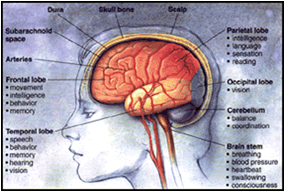
The following is a Power Point presentation she has provided that explains many of the technical aspects of a stroke. I have modified it and converted it to a multi-part series in blog format. (Please forgive the blurriness of the first picture. It's the best I could do during the conversion from Power Point to blogger format)


In this picture you can see the different lobes of the brain. It also shows some important areas within those lobes, such as speech areas, vision areas, and areas for reading and comprehension. Damage to these specific areas will result in difficulty with speaking, understanding what is being spoken, problems with vision, and balance.

The left side of the brain controls the right side of the body, language centers and logical thinking.

The right side of the brain controls the left side of the body, recognition and sensory/spatial perception.

With the brain, the right side of the brain controls the left side of the body and vice versa. The right side of the body (arm and leg ) will be affected with a left sided stroke. The left side of your brain also controls logical thinking and your language.

The right side of the brain is responsible for vision and recognition. It also controls the movement and sensation of the left leg and arm. The brain is a very complex and important organ. Any interruption to the normal functioning of the brain can cause many problems.


Brain Attack

Strokes happen in the brain. The “Brain attack” term is used to show that a stroke is as serious as a heart attack. Lack of blood supply to the brain results in damage to the brain tissue causing injury to the brain. Without adequate blood supply the brain tissue dies. Stroke symptoms will depend on the size of the stroke, the location and vessel in the brain that is injured.

Stroke Symptoms


Types of Strokes
- Ischemic
- Hemorrhagic

There are two types of strokes. If you think about stroke as a plumbing problem an ischemic stroke occurs when the pipe gets clogged and a hemorrhagic stroke occurs when the pipe bursts.

Ischemic Strokes


Here are some examples of how the pipe can clog. An atherosclerotic clot is caused by fatty plaque buildup in the vessels. These fatty deposits stick to the vessel wall and caus narrowing, slowing down the flow of blood. As these fatty plaques build up, the vessel looks at this as an injury and sends out cells to repair itself. This causes a clot to form and either stops the blood flow to the brain or the clot can break away from the vessel wall and travel to the brain. This is called a thrombotic stroke

A blood clot that travels to the brain is called an embolic stroke. These are usually caused by a wandering blood clot, usually from the heart or the neck vessels. Atrial Fibrillation( which is an irregular heartbeat) or a PFO ( which is a small hole between the chambers of the heart) may be the reason these clots form and are carried in the blood stream, clogging the vessels leading to the brain.

When this happens blood supply to that area of the brain is cut off and brain injury occurs.


Hemorrhagic Strokes


Another type of stroke is called a hemorrhagic stroke. This is when the pipe or vessel bursts and blood is spilled into the brain. This is a CAT scan picture of bleeding into the brain. The white area shows where the bleeding has occurred.


An arteriovenous malformation is an abnormal cluster of arteries and veins all tangled together. These tangled vessels in the brain can rupture and bleed, causing a stroke.


Aneurysm

A weakened area or a ballooning of a vessel wall

An aneurysm may happen in an area of the vessel where it splits….kind of like a T in the road. The blood vessel weakens and the vessel wall balloons at the split. The aneurysm can grow very large. The walls of the aneurysm become very thin and finally ruptures spilling blood into the brain. This is called a subarachnoid hemorrhage.


Cause of Hemorrhagic Stroke

Long standing Hypertension: High blood pressure that is not
controlled adequately. There are some reasons why the pipe
bursts. Long standing high blood pressure that has not been
controlled can weaken the vessels over time and cause them to
leak or burst.

I hope this gives you a little insight of what a stroke is and a little idea of what the brain looks like and its many functions. In the near future I will be covering other topics such as some diagnostic tests stroke survivors will experience in the hospital and different types of treatments while there, what stroke survivors may expect while in the hospital and later when released, managing risk factors, rehabilitation, and what support is available after the survivor has been released from the hospital.

Sunday, June 28, 2020

How Healthy Sleep May Prevent Strokes


www.strokecamp.org


http://www.unitedstrokealliance.org/


*****************************************************************

*****************************************************************
While at our Lincoln stroke camp, August 2013, I met Marcia Matthies, Outreach Coordinator for the Nebraska State Stroke Association. She gave me permission to reproduce on our blog any article they have on their site.

This article is packed with information on sleep apnea, and includes many links to even more information.

The following is taken from the Nebraska State Stroke Association web site (www.nebraskastroke.org). 

Thank you Marcia

*****************************************************************
How Healthy Sleep May Prevent Strokes
March 31, 2020

Since stroke is the fifth most common cause of death in the United States, people are eager to find ways to prevent it. Research suggests that sleep health is a major factor related to stroke risk. There is strong evidence that obstructive sleep apnea in particular significantly increases a person’s risk of having a stroke.

This page contains an overview of the many research studies on sleep health and strokes. It also contains information on how to prevent sleep issues that could potentially increase a person’s risk of having a stroke. While the link between sleep health and stroke is not perfectly understood, improving one’s sleep health is beneficial in general, and likely also beneficial in regards to stroke risk.

How Sleep Health Can Cause or Prevent Strokes

Stroke is the fifth leading cause of death in the United States. A stroke happens when a blood clot travels to the brain and blocks a blood vessel, or when a blood vessel in the brain bursts. The following are signs of stroke:

Sudden numbness or weakness, often on one side

Sudden difficulty speaking or understanding
Sudden severe headache
Sudden sight problems
Sudden dizziness or trouble walking

Because strokes can be so deadly and damaging, researchers have been studying how to prevent them for decades. They’ve found many factors that put people at risk for stroke. Some are uncontrollable, such as race, age, the presence of certain genes, and having a low birth weight. Other stroke risk factors include physical inactivity, high cholesterol, high salt intake, high alcohol intake, high blood pressure, obesity, diabetes, cigarette smoking, and more.

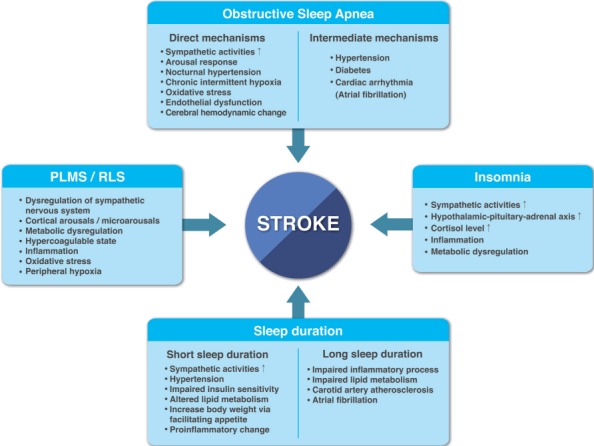
Researchers have found that there is a connection between sleep and strokes. The connection between obstructive sleep apnea and strokes is the most well-documented, though there is also a connection between strokes and other sleep disturbances. The following sleep issues are potentially related to strokes:
Obstructive sleep apnea
Central sleep apnea
Insomnia
Restless Leg Syndrome (RLS)
Periodic Limb Movements of Sleep (PLMS)
Sleep loss
Too much sleep


Source: Journal of Stroke

Can Sleep Apnea Cause Strokes?

While researchers do not confirm that there is a direct cause-and-effect relationship between sleep apnea and stroke, they do state that the disorder is an important risk factor for stroke. People who have sleep apnea should take their stroke risk as seriously as those who have high blood pressure or diabetes, or who smoke cigarettes. There are several ways obstructive sleep apnea impacts the body that might explain why it increases stroke risk:
Increased sympathetic nervous system activity
Increased inflammation
Reduced insulin sensitivity
Decreased ability to break down fats
Other cardiovascular and metabolic dysfunction

Researchers recommend that stroke patients undergo a polysomnography, or sleep study, to test for obstructive sleep apnea. Many stroke patients end up having another stroke. Treating obstructive sleep apnea through the use of a CPAP machine may reduce the recurrence of stroke.

A connection between central sleep apnea and strokes has not been confirmed, but central sleep apnea is clearly connected to cardiovascular disease. Cardiovascular problems are closely associated with stroke, so it could be that a clearer link between central sleep apnea and strokes will be found in the future. Anything that negatively impacts the cardiovascular system could potentially increase stroke risk.

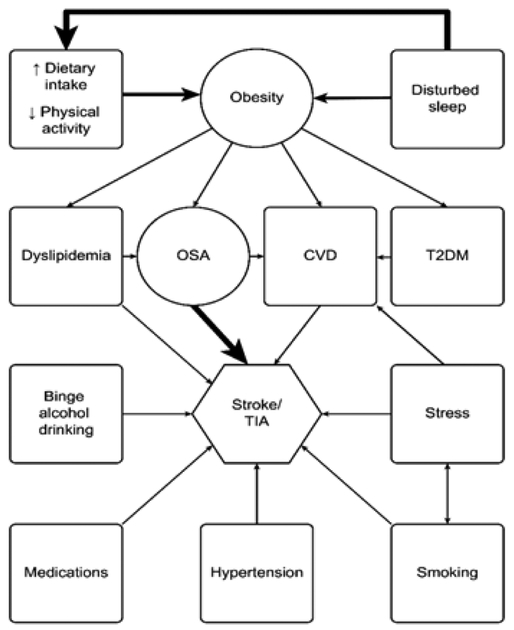
One study on obstructive sleep apnea noted that disturbed sleep increases the chance of obesity both directly and by leading to increased food intake and decreased physical activity. Obesity increases the chance of developing obstructive sleep apnea, which along with other factors, increases stroke risk. In this model, disturbed sleep does play a role early on in the path to stroke.


Source: Sleep Medicine and Disorders

Other Sleep Issues and Stroke

Sleep apnea isn’t the only sleep-related issue that increases a person’s chance of stroke. One study showed that non-apnea sleep disorders (NSD) increased stroke risk, particularly in men and the elderly. Non-apnea sleep disorders refers to any sleep disturbance that can’t be attributed to sleep apnea, such as insomnia, sleep disturbance, hypersomnia (too much sleep), disruptions of the 24-hour sleep/wake cycle, sleep-related movement disorders, and any other sleep problems.

Sleep duration is also related to stroke. One study found that both people who sleep less than five hours or over nine hours per night are at an increased risk of dying from stroke or heart attack. This result held true regardless of age, sex, race, smoking status, and body mass index (BMI). While the reason for abnormal sleep duration wasn’t studied, it’s likely that some of the people not obtaining enough sleep have insomnia.

Another study found that people who slept over ten hours per night were more likely to die from cardiovascular problems, including stroke. This could be due to poorer health in those sleeping for longer durations, however.

Studies suggest that movement disorders such as Periodic Limb Movements of Sleep (PLMs) and Restless Leg Syndrome (RLS) are also potentially related to stroke incidence. One study found that more PLMs are associated with White Matter Hyperintensities (WMHs), a blood vessel state that can precede stroke and other cardiovascular issues.

How to Lower the Risk for Stroke With Healthier Sleep

Research demonstrates a connection between sleep issues and strokes. There is strong evidence that having obstructive sleep apnea puts a person at a higher risk for stroke. There is also a clear correlation between sleep duration and stroke incidence, with people who sleep both too little and too much being at greater risk for stroke.

The relationships between stroke and other sleep problems aren’t as certain, though it appears that movement disorders such as Periodic Limb Movements of Sleep (PLMs) could put people at a greater risk of stroke.

Given all of the research on stroke and sleep, people wanting to lower their risk for stroke might consider improving their sleep quality. Anyone suspecting they have a sleep disorder of any kind should consider seeing a sleep specialist and possibly undergo a polysomnography, or sleep study.

Sleep studies and other testing can help doctors determine if a person would benefit from sleep medications or other sleep-related treatments.

Preventing and Treating Sleep Apnea

Sleep apnea is a disorder in which the sleeper has trouble breathing throughout the night. It increases a person’s risk of stroke and is often accompanied by snoring. Here are evidence-based methods for preventing obstructive sleep apnea:
Weight loss in people with obesity
Avoiding the back (supine) sleeping position
Cessation of cigarette smoking

Doctors generally treat sleep apnea by instructing patients to use a CPAP machine, which blows air into the nose and mouth throughout the night. Researchers suspect that CPAP machine use could potentially prevent Transient Ischemic Attacks (TIAs), which are essentially mini-strokes. Their research was preliminary, however, and they recommend larger, controlled studies to determine how well CPAP machines prevent TIAs.

A recent study reported that CPAP machines can reduce the recurrence of stroke and death in patients who have already had a stroke. Other studies show that CPAP machine use decreases blood pressure. This effect is even seen in patients who have high blood pressure that is resistant to treatment.

Since high blood pressure is a risk factor for stroke, CPAP machine use could potentially reduce stroke risk by lowering blood pressure, even in people who have never had a stroke before.

Sleeping for a Healthy Duration

What is considered a healthy amount of sleep depends on a person’s age. People who consistently have trouble sleeping within the healthy range for their age might consider seeing a sleep specialist and undergoing a sleep study. Healthy sleep durations for each age group are as follows:
Newborns: 14 – 17 hours
Infants: 12 – 15 hours
Toddlers: 11 – 14 hours
Preschoolers: 10 – 13 hours
School-Aged Children: 9 – 11 hours
Teenagers: 8 – 10 hours
Adults: 7 – 9 hours
Older Adults: 7 – 8 hours

Sleeping too much or too little is associated with an increased incidence of stroke. There are many different reasons a person might sleep too much or too little, and actions to improve sleep duration will vary depending on the individual. If there is an underlying physical illness or mood disorder affecting a person’s sleep, treating that is important.

If not, there are other actions people can take to help them sleep an ideal amount, such as:
Block out unwanted sound using earplugs or a white noise machine
Avoid drinking excess amounts of alcohol, particularly before bed
Avoid caffeine and other stimulants, particularly before bed
Go to bed and wake up at the same time every day to create a healthy circadian rhythm
Block out light using a sleep mask or blackout curtains
Adhere to a bedtime routine

Preventing and Treating Periodic Limb Movement Disorder
Research shows that Periodic Limb Movement Disorder (PLMD) could contribute to stroke risk. PLMD often overlaps with restless legs syndrome (RLS), narcolepsy, and sleep apnea. The following are ways to prevent and treat PLMD:
Test for other sleep disorders and treat them as necessary
Check medications’ side effects as limb movements can be a result of medications
Test for and treat any other underlying health issues that often accompany PLMD, such as anemia and diabetes
Exercise regularly

Final Thoughts

Sleep issues are one of the many risk factors for stroke, alongside other factors such as obesity, diabetes, cigarette smoking, high cholesterol, high blood pressure, high alcohol intake, high salt intake, physical inactivity, and more. Preventing strokes in individuals and the larger population likely requires a multipronged approach. One strategy for preventing stroke is improving sleep health.

Obstructive sleep apnea is the sleep disorder that has been studied the most in terms of its relationship to stroke. People who have obstructive sleep apnea are at a much higher risk for stroke than people who do not have the sleep disorder.

Central sleep apnea might also contribute to stroke risk since it increases cardiovascular problems. As of now, however, the link between central sleep apnea and stroke risk is not as clearly defined as the link between obstructive sleep apnea and stroke risk.

Other sleep issues beyond apnea appear to also affect a person’s stroke risk. These issues include an abnormal sleep duration, whether that is too much or too little sleep each night, and sleep movement disorders.

Although researchers cannot guarantee that improving sleep will prevent stroke, it is a healthy action worth taking. Early research suggests that CPAP use can reduce stroke risk in people with sleep apnea.

As more sleep-and-stroke-related research is conducted, more connections will likely be found. Pursuing healthy sleep is a worthwhile endeavor anyone, but may have additional benefits for people wanting to prevent stroke.

Additional Resources

If you’re interested in strokes and sleep, these articles might also be of interest to you:

Sleep-Related Breathing Disorders
Obstructive Sleep Apnea
Heart Disease and Sleep
Insomnia
Sleep Health
New Study Finds Sleep Apnea Treatment Can Reduce Hospital Readmissions

Sunday, June 21, 2020

Strike Out Stroke event at Dozer Park


www.strokecamp.org


http://www.unitedstrokealliance.org/


*****************************************************************

*****************************************************************
If COVID-19 hadn't happened, June 19th would have been our local 12th annual Strike Out Stroke event at Dozer Park - Home of the Peoria Chiefs! It's always a fun night of stroke awareness, family, and baseball! 


Image may contain: 1 person, sky and outdoor

Typically our very own Chime Strokers group open the evening by playing the National Anthem and 'God Bless America' on their hand held chime instruments.

Next, we all watch the OSF Life Flight helicopter descend and land in the center of the ball diamond. 


Image may contain: sky and outdoor


Image may contain: 1 person, outdoor


The Grand Prize winner of the POSTER CONTEST for the Youth Education on Stroke program along with a parent, gets out of the helicopter to walk to the pitcher's mound to have the honor of throwing out the first pitch!

Image may contain: one or more people, baseball, sky and outdoor


Image may contain: 2 people, outdoor
Winner and Dad

Image may contain: one or more people, people playing sports, baseball, sky and outdoor

Image may contain: 1 person, outdoor


Image may contain: 3 people, people standing and outdoor
Winner and Mom

(We display the other winning posters throughout the park for people to see and learn). 

Image may contain: 3 people, people standing, beard and outdoor

Image may contain: one or more people, shoes, basketball court and outdoor


No photo description available.
GRAND PRIZE WINNING POSTER

Image may contain: 1 person, standing and outdoor


No photo description available.

Image may contain: outdoor

Then it's game time where we all cheer on our Chiefs and spread the message of BE-FASTER!! 

We do pitch-in-for charity to raise money for United Stroke Alliance, and people win BIG prizes by throwing tennis balls from the stands into large rings positioned around the ball field!! 

Image may contain: sky and outdoor


Image may contain: 1 person

The night usually ends with a fantastic display of fireworks!...oh how we will miss it this year. But we have these wonderful memories of last year's (2019) game to get us through until next year!

Image may contain: 2 people
Jan Jahnel on the right Pam Casper on the left

This fun filled day at the semi-pro Peoria Chiefs ball park, and the ability to save lives, would not be possible without the help of OSF Saint Francis Medical Center, Jan Jahnel, their Illinois Neurological Institute Stroke Coordinator, United Stroke Alliance and Retreat & Refresh Stroke Camp.

Sunday, June 14, 2020

What is a Stroke Camp?


www.strokecamp.org


http://www.unitedstrokealliance.org/


*****************************************************************

*****************************************************************
MaryLee Nunley of Peoria, Illinois, a caregiver, shares what it’s like to attend stroke camp with her husband John Nunley, who was 55 at the time of his stroke. Now married 24 years, Marylee is the founder of the non-profit organization United Stroke Alliance and is currently head of its Stroke Camp division.

After her husband had a stroke, this caregiver founded a nonprofit stroke camp, which offers support and reduces stress for both 
caregivers and stroke survivors.

Saryn Chorney, an independent freelance writer for Readers Digest thehealthy.com , interviewed Marylee for inclusion in their newsletter. What follows is that portion of the interview about Retreat & Refresh Stroke Camp.
*****************************************************************

I Went to Stroke Camp. This Is What It’s Like

Saryn Chorney
Updated: Jun. 04, 2020

What is a stroke camp?

Our first stroke camp

John and I started our first stroke camp in 2004 as a place people could go to relax and have fun. The first stroke camp location was at a church that I had attended as a youth and where my sister and her family had held camps for children with cystic fibrosis (prior to John’s stroke).

We had support from a local hospital and a local neurologist to fund the first camp. John had volunteered for a cystic fibrosis camp before we were married, so he knew what a difference it could make for people struggling with [similar] challenges. He was very glad to be entering into this new venture.

Stroke camp accommodations

Camps are held in a variety of locations, and accommodations vary from more of a camp setting all the way to hotels and retreat centers. Each unit for stroke survivors has a private room with a private bathroom. These are 3-day weekend retreats that cost $125 per person. They are located all over the country, although some have been delayed or rescheduled due to Covid-19.

The stroke camps are intentionally small in order for survivors and caregivers to enjoy an intimate setting where they really get to know each other. They are typically groups of 18-20 survivors, their caregivers (not required if the survivor is independent), and volunteers from sponsoring hospitals.

Hospitals, foundations, rehab centers, and stroke centers provide volunteers, and our non-profit organization provides a team to lead the weekend, for a total of about 60 people.
Meals, physical activities, and self-care

Meals are usually pretty nice and served buffet style; there is variety and dietary needs are met. Saturday night’s meal is always something special. Activities are adapted so everyone can participate, they include discussion, pampering, education, socialization, support, crafts, outdoor activities and more. There isn’t much “down time,” but naps are possible.

A lot of chatting takes place, crafts are available and board games abound. Some locations have boating and swimming, so there’s never time to be bored. Pampering time (pre-pandemic) includes mini-manicures, chair massage, warm paraffin hand dip, crafts, foot and leg massaging equipment, relaxation with music, sometimes yoga, and chair Tai chi.

I had been involved in church camps and another camp for disabled children [in the past], so I was pretty confident the retreat for our stroke friends would be fun and fulfilling. As my husband often says, he loves to greet campers as they arrive unsure what they’ve gotten themselves into.

John’s favorite activity is the pampering chair massages and paraffin hand dips, complete with a hand massage. He also just loves to sit quietly and visit with campers as they arrive, and see how they react to this unique event. My favorite time is the discussion circles with caregivers and our Saturday night show where we encourage dancing and offer a sort of a “date night” atmosphere for everyone.

At stroke camp, [people] dance in their wheelchair or with a cane, that doesn’t always happen elsewhere in society. Watching [the weekend] unfold is a beautiful thing. Each year we have a specific theme; 2019 was the Hollywood Red Carpet theme.

A break for stroke family caregivers

The thing that surprised me is how unique [our camp was]. Hardly anyone else was doing anything similar, so that’s how the nonprofit came to be. The Retreat & Refresh Stroke Camp has a 70% return rate, so we know that we’ve succeeded in putting together a good program.

The feedback we hear most is that people feel “normal” for a weekend. They enjoy the camaraderie and encouragement, and they often say it gives them a reason to keep working hard and trying as they see people many years post-stroke still improving.

Caregivers are happy to get a break from the day-to-day responsibilities since the group activities engage everyone. Not having to plan or cook six meals is also on the top of most caregivers’ lists.

The biggest challenge for me as a caregiver is that there is always something that needs to be done: always another task, appointment, load of laundry, prescriptions to be filled, pills to be counted out, meals to cook, nails to trim, housework to do and more.

I think the biggest relief for caregivers at the camp is that there are discussion times where caregivers meet with only caregivers and volunteers, and they are free to say whatever they want in a safe and confidential setting.

[editor note: and survivors meet with only survivors]

Sharing and having others understand and validate your journey is priceless. There are also a lot of tips that are shared and things are learned that you don’t hear at a doctor’s office. I learn something new at each and every camp I attend.

John and I married later in life and his stroke was 4.5 years into our marriage. I’d be lying if I didn’t say that much of [caring for a survivor] is like childcare, especially because of John’s aphasia, or language impairments, and cognitive deficits. I don’t treat him like a child, it’s the being in charge of someone else’s life that’s like childcare.

Much of it doesn’t show outwardly when meeting him for a short time in a social setting. The fact that he can’t read, manage any of his medical needs, medications, etc. puts me in the position of having to be in charge of a lot. We are still partners and I include him in whatever I can. We are in a good rhythm now, but it took years for us to adjust to the new way of life.

Stroke camp is for both children and adults

Strokes can happen at any age, even in children. Our youngest camper was six and the oldest 91 years old. For most camps, the average age is probably between 58-75. We do hold one camp we call our family stroke camp that includes young stroke survivors who are raising children. That age range is approximately 32-50.

They bring their children and we have time for the children to discuss and process what it’s like living with a parent struggling with the effects of stroke. It provides hope to this age group, and allows them to have fun and feel energized. [In general], we have more male survivors than female survivors at stroke camp.
That makes more female caregivers and fewer male caregivers.

[editor note: according to statistics, more women have strokes than men, yet our camp's turnout is the opposite.

I’ve learned a lot from male caregivers, though. One gender difference that I’ve noticed, though not universal, is that men just want to know how to get things done and do what needs to be done. We women seem to always second guess ourselves.

Stroke recovery is a lifetime of work

I always leave stroke camp revived, and that seems to be true for most our campers. At least that was the finding of a survey conducted by a research team, which published the results in a 2016 study in the journal Stroke.
I have learned that I’m not alone and there are people out there who understand stroke and the day-to-day challenges. Strokes take a lifetime of work as you continue recovery.

To be able to enjoy improved recovery for my husband, help others, and encourage them to keep trying has been the very best experience of my life. United Stroke Alliance grew from suggestions from our campers who wanted more people to know the signs of stroke, be aware of those signs, and help others to have a better recovery by responding quickly. That is how the program grew and the United Stroke Alliance could focus on prevention, awareness, and recovery.

—As told to Saryn Chorney