By Monica Vest Wheeler
I've heard and seen enough at Retreat & Refresh Stroke Camps since the summer of 2008 to fill a couple dozen books just about camp and the amazing array of individuals who gather at these unique weekends.
The survivors, caregivers, volunteers and staff who gather at each of these weekend events were brought together for a reason. Executive Director Marylee Nunley often says everyone who is there was meant to be there, and that's why every camp is so different, even if a single theme is followed an entire year. It's all about the people.
I've scribbled countless notes through the years, and I have discovered an abundance of "one liners" within this collection. These are statements or simple observations that have been uttered or written at camps by anyone and have left a powerful impression upon me.
Yes, I'm ALWAYS listening and watching and absorbing. Revisit some of these moments with me …
• A volunteer wipes her eyes, tearful at the conclusion of a camp weekend and looks at the survivors: "My legs hurt, but you take a step forward every day. You’re all my heroes.”
• A survivor announces, "I’m adjusting to the new life.”
Another reminds him, “Don’t regret the old life.”
• One survivor tells another, “One of these days, you’ll get those fingers moving. Sometimes it hurts, but you get used to the pain.”
• A survivor with aphasia writes on a whiteboard, “Where would we be without our mouthpieces (caregivers)?”
• A caregiver says, "I'm reinventing my dream in a new way."
• A survivor says, "My stroke made me stronger. I have a list of things I get to do, even if have to find a new way."
• A survivor reflects, "If I did one step every day, imagine how far I would get in six months."
• A survivor tells her fellow survivors, "Everybody has a choice. God has work for us, so get to it. No time for a pity party. We have a life to live."
• A caregiver says, "He doesn’t know where he’s coming from. I should have had video. I would have shown that to him to show his progress. He doesn’t know the difference."
• A caregiver explains, "I came across people who know how to see through you and read you. It was surprising when I'd find people who 'get it.' Hang onto that to get you through until you meet the next person to carry you through the next step."
**************************************************************************

Sunday, February 16, 2014
Sunday, February 9, 2014
Music Therapy - Enhancing Stroke Recovery
I have published music therapy articles on this blog before but I think this one is also worth passing on. This caught the eye of Marylee, our Executive Director, in the StrokeNet Newsletter web site she subscribes to. The article touches on some of the music and drum circle benefits we've noticed at our camps.
This article was originally submitted in their February newsletter by David Wasielewski, a member of the StrokeNet Newsletter staff:
At a recent stroke group meeting a member with significant aphasia described his experience in joining a singing group, how his ability to sing was almost unaffected by his aphasia and that he had noticed some improvement in his normal speech that may have resulted from the singing. Some investigation and an email from Avi Golden, a Stroke Network member, brought to light some interesting information that demonstrates that singing and Music Therapy can help recovery from stroke in a variety of unexpected ways.
Music therapy research has demonstrated that this is an appropriate treatment for brain trauma recovery such as stroke. ‘Music therapy programs provide opportunities for clients to learn alternative means for undertaking daily tasks to accommodate for the neurological impairments that inhibit brain and physical function.’ It helps clients develop capabilities to recover what has been lost. Music Therapists can use music as a planning and memory tool.
Complex tasks are incorporated into a ‘song lyric’ to help survivors remember and organize all aspects of a complex task such as making a sandwich or getting dressed. Occupational and physical therapists have found that exercising to music helps survivors enhance recovery of physical functions, much the same as music helps healthy folks with ‘normal’ exercise routines. As we survivors often hear, much of the recovery from the trauma of stroke is dependent on neuroplasticity or the ability of the brain to rebuild function by developing new neural connections.
All Therapies encourage the rebuilding and of lost skills (recovery) or finding another brain function that allows the survivor to accomplish a task in a different way (compensation). Research in Music Therapy focuses on the ‘perception and production of music’ and its ‘effects on brain and behavior’. These effects on the brain can be categorized. One area of research focuses on how music and auditory stimulation relates to the synchronization of rhythmic physical movement.
Dance and jazzercise are examples of how music facilitates movement and physical memory. Does music enhance the brain’s ability to learn new motor skills? This research touches on the notion that music and its rhythmic character promote the synchronization of many related brain activities and that the simultaneous firing of these multiple groups of neurons helps promote recovery from the trauma of a stroke.
This follows the popular notion that neurons that fire together, wire together, creating effective new circuits. Repeating an experience utilizing musical rhythm enhances development of these new circuits and recovery of brain function. Music therapy is effectively administered according to the Neurologic Music Therapy (NMT) model. Researchers have demonstrated that gait training, walking with auditory stimulation, music, is more effective than without that stimulation.
The same favorable effect has been demonstrated in non-physical functions. One researcher describes a client who could not accomplish the complex task of getting dressed in the morning. After learning a song that described the task, the patient became much better at completing the task independently. The stimulation of rhythm and language improved the client’s memory, motor planning and proper sequencing of dressing activities. Song lyrics supplemented with a melody and tempo helped overcome his deficits.
Aphasic patients see similar benefits. Survivors who undergo intense musical therapy are able to better generate phrases in ‘out of therapy’ situations. Aphasic survivors who have difficulty with word retrieval are able to self- generate learned auditory cues to help with word recovery. Music therapy and singing have been successful with increasing vocal range, breath control and rate of speech.
The demonstration of successful new music therapy interventions offers survivors alternatives and supplements to traditional PT and OT therapies. The added variety of brain stimulation provided through Music Therapy is not only effective in enhancing speech therapy but has also proven to be effective in non-speech related tasks like gait training and recovery of other physical functions.
Based on this research survivors might explore Music Therapy to supplement their current traditional treatments. A conversation with your therapist might lead to some additional progress in recovery
Thanks to Avi Golden and my stroke support group for suggesting this topic.
Reference: Neuroplasticity and Functional Recovery: Training Models and Compensatory Strategies in Music Therapy Baker, Felicity: Roth, Edward A. Nordic Journal of Music Therapy, 13(1) 2004, pp. 20-32.
-----------------------------------------------------------------------
If you are interested in subscribing to the StrokeNet Newsletter go to:
It's free and there are many good articles on stroke related issues.
****************************************************
Sunday, January 26, 2014
Stroke Camp is a “safe adventure”
By Monica Vest Wheeler
“Safe” is one of those words that has so many meanings, from protected and guarded to that box where we lock away our precious material possessions. “Adventure” is described as an exciting or unusual experience, which may involve risk.
From the moment I arrived at my first Retreat & Refresh Stroke Camp in June 2008, I discovered that the terms “safe” and “adventure” are perfect and fitting companions, and beautifully describe the camp experience.
As a volunteer and while collecting information for my books, I've interacted with hundreds of campers over the years, and a frequent theme of “courage” emerges. It does take a tremendous amount of courage for many stroke survivors and their caregivers to venture out into the “normal world,” where the effects of stroke may be glaring to the uneducated, with physical, emotional, cognitive, speech and other challenges.
During the numerous conversations I've had RRSC executive director Marylee Nunley, we've often noted the “safe” component of camp, where survivors and caregivers have a chance to share experiences in much more depth than the standard hour-long monthly support group setting. It's so refreshing and rewarding to engage in each other's lives and “live together” for nearly 48 hours.
At the same time, they don't worry about people staring at them in curiosity or simply ignoring them. Everybody at camp “gets it.” Do you realize how important, how fulfilling, how empowering, how human that is? Being accepted when you have difficulty speaking, when you need a wheelchair to get around, when you need some help cutting the meat on your plate? Do you know how incredible and amazing it is to have fellow caregivers who understand similar challenges and joys?
I've witnessed countless survivors and caregivers take risks they wouldn't consider exploring elsewhere. What are those “big” risks? Playing the drums, asking questions, playing games, allowing themselves to be pampered, singing or performing in front of an audience, acknowledging their fears, sharing what's on their heart, and laughing, laughing, laughing! Stroke Camp is the largest cheering block most of our families will ever find in a post-stroke world, and for some, it's a stepping stone to discovering even bigger and better adventures and audiences awaiting the gifts only survivors and caregivers can offer.
Start packing your bags! Another great Stroke Camp adventure is in the works! Tell other families they need to experience the safest adventure of their lives this year!
********************************************************************************************************************************************************************
********************************************************************************************************************************************************************
Sunday, January 19, 2014
Memories of my first Stroke Camp - Monica
By Monica Vest Wheeler
This is the third in a series of articles written by Monica Vest Wheeler. If you missed the other two at the end of December 2013, now is a good time to get caught up. Just look for her name at the end of the title.
The concept of Retreat & Refresh Stroke Camp was a whole new experience when I attended my first camp in June 2008. Though I clumsily offered my services as a volunteer, I spent more time people-watching and listening than lending a hand.
 I watched this group of individuals, each with their own story and background, meld into a group that quickly found collective joy, support and encouragement.
 When I first talked to executive director and founder Marylee Nunley weeks earlier, she had explained that everybody wants to tell their story, because stroke is the most dramatic trauma many of these families had ever experienced. Why? Because it changed them and the course of their lives forever. Most say it’s “bigger” than cancer or heart disease with its memory, cognitive, speech or paralysis challenges.
 Marylee said the biggest task is often having to accept the fact that the survivor won’t be the same person they were before because of abrupt shifts in physical, emotional or cognitive abilities, but “what can I do to be the best I can given the circumstances?”
“You don’t lose the person, but there are a lot of behaviors altered,” she explained. That’s hard for many people, and some may feel sorry for themselves.
“I’m so blessed to have a positive attitude and a family of origin that always turned things around. I feel like it’s my mission to give back and encourage and cheer all these people on. Besides encouraging the survivor, the caregiver is often the overlooked individual. I am blessed with a wonderful, supportive family, a positive attitude and a lot of energy. Many folks are not.”


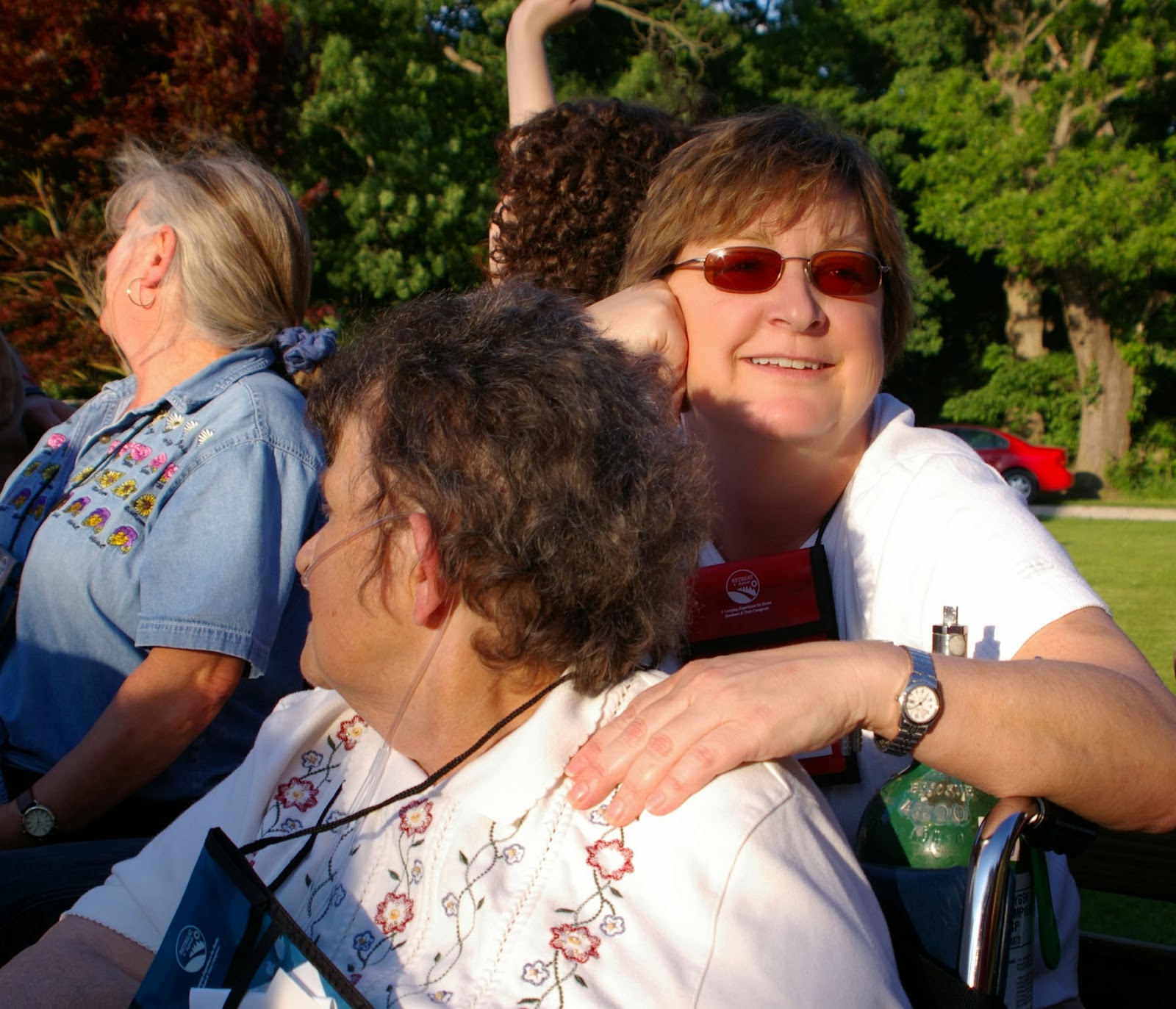
As I watched campers and volunteers move from one activity to the next, I witnessed this overwhelming, yet not smothering, sense of family.
A tractor pulling a trailer, affectionately called “the people mover,” took everyone on an old-fashioned tour of the grounds. As I bumped along with everyone else, I could not mistake how something so simple could create such joy … the smiles, the laughter, the hand-holding, hugs and soul-refreshing relaxation.
The family-style meals created a real sense of community as volunteers gave the caregivers a break and offered survivors any assistance they needed in serving or cutting meat. I remembered what Marylee had told me earlier.
“If you can’t find a word, then somebody will help you. If you’re drooling and don’t have sensation on one side, if the food is there, we’ll just hand them a napkin and say, ‘Oops, let’s tidy up here.’ We all know that’s the way it is with surviving a stroke.” She said many stroke families don’t go to nice restaurants anymore because of the stigma or feeling embarrassed.
 The term pampering took on a whole new meaning when I watched the other volunteers give campers massages and manicures on Saturday morning. All who indulged in the back rubs were visibly relaxed as their pace of breathing slowed to give tired and tense muscles a reprieve from constant stress. They played games, joined in crafts, and some even climbed the rock wall.
At the close of the weekend, an abundance of hugs and voices rich with appreciation and love swirled around me. Nobody wanted to leave, even though they knew this much-deserved vacation had
I didn’t want to leave either. I was addicted. After 40-some camps, I’m still here and looking forward to embracing the love, laughter, adventure and everyone I will meet this year.

**********************************************************************************
Sunday, January 12, 2014
Physical Therapy After a Stroke
by Chuck Jones
I'm not a medical professional I'm a computer geek so, before acting on anything I say in this post, I suggest you talk it over first with your doctor or physical therapist (PT). Recovering from the effects of a stroke is the most difficult thing a survivor and caregiver together must face when he or she returns home from the hospital. When a person suffers a stroke it has been estimated that they are losing 1.9 million brain cells per minute. You can see how this rapid deterioration, if left unchecked, is going to eventually seriously affect a persons physical well being as well as their mental one. The length of time this is allowed to go on is then going to affect how severe the deterioration is going get.
Stroke survivors have to relearn things previously taken for granted, perhaps, all over again. How much is determined by the factors mentioned above. Fortunately the brain can be retrained. With physical therapy the brain can be convinced it must try to repair or reroute paths around the damaged areas that used to control those muscles or mental faculties before the stroke. I'm going to be addressing only the physical part in this post. That damage can range from extreme weakness to an affected limb to that limb being completely paralyzed. Physical therapy with a licensed physical therapist is essential to get those arms and legs working again. We are talking about sitting, standing, walking, even something as simple as getting in and out of bed or a car. From the camps I've been to, I have seen how difficult these seemingly simple things can be to a survivor. But, as difficult as they are to them, they can be conquered to a great degree, if not completely, with physical therapy.
Oh, and you may have wondered what the difference is between physical therapy and occupational therapy, both being essential elements towards recovery? A simple explanation is that an occupational therapist helps you learn how to do things like feed and dress yourself while a physical therapist helps with muscle building and mobility training, i.e.: the sitting, walking, moving about I mentioned earlier.
The goal of the PT is to get the survivor moving as soon as possible and getting them to do this on their own. This is pretty much true for any type of hospital stay where motion has been affected, such as knee replacements and the like. You don't want those muscles to atrophy. After an evaluation of the patients condition, the PT will decide what needs to be done and many times, if the patient can't do it on their own, the PT will begin by doing it for them. The important thing is to get those muscles working.
It's very important to note that the survivor is not and should not be alone in this. Caregivers and family members need to be involved also. Much encouragement and positive reinforcement from others is needed, and I believe the speed of physical improvement is directly related to how much and how often this is given. Expect the physical therapist to get others involved in sessions.
Physical therapy will often start in the hospital but it will, and must, continue even after discharge. The same therapist may even be involved but, if not, there are other programs and physical rehab centers available. The hospital should be providing this information prior to discharge.
Of course, there is that ugly head of rehab costs that always affect the amount that can be afforded. Everyone's insurance and financial situation is different and so complicated I won't even attempt to cover that now. Just get it and get as much as you can and learn what needs to be done and do it with or without extended professional help. However, I believe recovery is faster, easier on the caregiver and more complete with professional care.
Here is an excellent link that can describe rehabilitation much better than I can in this space.
http://www.webmd.com/stroke/tc/stroke-rehabilitation-what-to-expect-after-a-stroke
Sometime in the near future I'll describe some of the exercises that are taught by the physical therapist. I won't be able to show you how to do them properly but I think I will be able to give you a general idea of what they are. Physical therapy is much more complex than what I can describe in a blog and a physical therapist is essential to make sure they are done correctly and without introducing more damage.
*********************************************************************************
Sunday, January 5, 2014
How Do We As A Camp Survive?
by Larry Schaer, Loren Kramer and Chuck Jones
Trivia Night
We have "Trivia Pursuit" nights in the spring and fall. We have a fee for tables made up of teams of eight players. Snacks, a meal and drinks are included. We provide raffle baskets, door prizes, and sometimes a silent auction. We offer the raffle baskets and a 50/50 drawing as a way to raise additional funds. There is a 1st, 2nd, and 3rd place award for the top teams. Attendees enjoy the event and at the same time we generate some funds. All the tables are sold out within a couple weeks of our announcement.
IronMan Golf
We've been doing an IronMan golf outing in the fall for several years. This event is a 7am to dusk golf marathon where, starting early in the morning, volunteer golfers must golf for the whole day and try to get as many holes of golf in as they can before it gets dark. You don't have to be good, you just have to be fast and have the endurance. And, I suppose you have to love golf to do this. We provide the golf course, golf carts and cart drivers, and food and drinks for this event. The golfers use their own equipment. The job of the volunteer cart driver is to assist the golfer with whatever is necessary for the golfer to play as fast as possible. The event takes place at a local public course and the course starter makes sure that all non-participating golfers that day have the understanding that our "IronMan" golfers have priority on the tees, fairways, and greens and must allow them to play through. This has worked very well and the non-participating golfers are always glad to step aside momentarily to help us get those holes in. Before the event, the golfers get pledges from "sponsors" for so much per hole. One of our volunteer golfers set a record of over 350 holes before dark. He is truly an IronMan!
Raffle Hall
Every Thursday we have volunteers who help staff the raffle hall at the Tazewell Festival Center in Creve Coeur, IL. This raffle parlor, owned and operated by Tazewell Bingo Center, helps charities and non-profit organizations, like us, raise money for our activities. Raffle is much like Bingo with enough differences to make it not be called Bingo. However, we also have a bingo license because the state mandates that we play a certain number of bingo games each session. Confusing? Yes! Our duties consist of behind-the-counter sales and distribution of raffle card media and raffle computer use, sales and distribution of various pull-tab gaming cards, verifying the validity of a game winning card or other winning media, distributing winner pay-outs, and periodically assembling promotional mailings for the hall. Sometimes we assist the game number-caller with the operation of the game. We do not call the raffle numbers during a game. They have a paid professional for that and a paid floor manager on-site to assist, direct and train helpers like us. They also have a cafe that serves food and beverages daily during game time. We usually have about six volunteers helping each Thursday. Volunteers usually work two Thursdays a month.
Strike-Out-Stroke(TM)
MegaBrain Events
If you can come up with any more ideas for fund raisers we can try, please let us know. We are trying our best to keep our camps going every year.
*********************************************************************************
As you all realize, the camp requires financial resources to
continue its mission. Historically, RRSC has survived on the revenue it obtains
from stroke camp sponsors. As we
continue to grow, we also need additional funding for local and national stroke
awareness programs through additional sponsors, grant and public donations. So, we do fundraisers throughout the year to support the
camps. Some of the things we have done in the past included a “Trivia Pursuit" nights a couple
times a year and the "IronMan"
golf outing once a year. We also work at a local Raffle (like Bingo) Hall every
Thursday night and we are just starting to get sponsorships for our
Strike-Out-Stroke™ events as well as
MegaBrain events at baseball games, malls, and fairs throughout the country.
Trivia Night
We have "Trivia Pursuit" nights in the spring and fall. We have a fee for tables made up of teams of eight players. Snacks, a meal and drinks are included. We provide raffle baskets, door prizes, and sometimes a silent auction. We offer the raffle baskets and a 50/50 drawing as a way to raise additional funds. There is a 1st, 2nd, and 3rd place award for the top teams. Attendees enjoy the event and at the same time we generate some funds. All the tables are sold out within a couple weeks of our announcement.
IronMan Golf
We've been doing an IronMan golf outing in the fall for several years. This event is a 7am to dusk golf marathon where, starting early in the morning, volunteer golfers must golf for the whole day and try to get as many holes of golf in as they can before it gets dark. You don't have to be good, you just have to be fast and have the endurance. And, I suppose you have to love golf to do this. We provide the golf course, golf carts and cart drivers, and food and drinks for this event. The golfers use their own equipment. The job of the volunteer cart driver is to assist the golfer with whatever is necessary for the golfer to play as fast as possible. The event takes place at a local public course and the course starter makes sure that all non-participating golfers that day have the understanding that our "IronMan" golfers have priority on the tees, fairways, and greens and must allow them to play through. This has worked very well and the non-participating golfers are always glad to step aside momentarily to help us get those holes in. Before the event, the golfers get pledges from "sponsors" for so much per hole. One of our volunteer golfers set a record of over 350 holes before dark. He is truly an IronMan!
Raffle Hall
Every Thursday we have volunteers who help staff the raffle hall at the Tazewell Festival Center in Creve Coeur, IL. This raffle parlor, owned and operated by Tazewell Bingo Center, helps charities and non-profit organizations, like us, raise money for our activities. Raffle is much like Bingo with enough differences to make it not be called Bingo. However, we also have a bingo license because the state mandates that we play a certain number of bingo games each session. Confusing? Yes! Our duties consist of behind-the-counter sales and distribution of raffle card media and raffle computer use, sales and distribution of various pull-tab gaming cards, verifying the validity of a game winning card or other winning media, distributing winner pay-outs, and periodically assembling promotional mailings for the hall. Sometimes we assist the game number-caller with the operation of the game. We do not call the raffle numbers during a game. They have a paid professional for that and a paid floor manager on-site to assist, direct and train helpers like us. They also have a cafe that serves food and beverages daily during game time. We usually have about six volunteers helping each Thursday. Volunteers usually work two Thursdays a month.
Strike-Out-Stroke(TM)
Approximately 3 years ago, Retreat & Refresh Stroke Camp
trademarked the term, Strike Out Stroke™.
Since that time RRSC has been developing a national stroke awareness
program through major and minor league baseball. In 2014, 16 major league and
50 minor league Strike Out Stroke events are being planned throughout the
country. In 2013, over one million
people heard about the signs of stroke and the need for immediate treatment at
our Strike Out Stroke™ events. The events are used to promote stroke awareness
in the nearby communities through exposure at the ball games with various
activities such as educational presentations, poster contests, pregame ceremonies
and public advertising. So far we have had SOS events with the Arizona
Diamondbacks, Texas Rangers, Seattle Mariners, Colorado Rockies, Chicago White
Sox, New York Yankees, Cincinnati Reds, Washington Nationals, St. Louis
Cardinals, Atlanta Braves, Minnesota Twins and San Diego Padres. Every year in June we have a Strike Out Stroke
event with the Peoria Chiefs minor league. The Peoria Chiefs are currently the
farm team for the St. Louis Cardinals.
MegaBrain Events
MegaBrain events feature a huge inflatable facsimile of the
human brain. The brain, when inflated, is about eight feet high and fifteen
feet square and weighs about 350 pounds, including air. It is constructed so
that people can walk through a tunnel going through the center of the brain
and, inside, learn about the various diseases, including stroke that can occur
in a human brain. Many times the brain is accompanied by a four laptop computer
or six Android computer tablet display we developed called ELSIE, which is an
acronym for Learning Center. ELSIE presents a multiple choice quiz about
strokes and stroke prevention and the meaning of the acronym F.A.S.T. used to
identify stroke symptoms. Usually, after taking the quiz, the participant is
rewarded with a memento promoting stroke awareness. In addition to the
ballgames mentioned above, ELSIE has been to the Peoria Northwoods Mall
sponsored by Illinois Neurological Institute, the health fair hosted by INOVA
Neuroscience Institute held at the Tyson Corner Center Shopping Mall in
Washington, DC, a professional hockey game of the Kansas City Mavericks
(incidentally, I got within five feet of the Stanley Cup trophy that
weekend), the Kansas City Black Expo at
the Kansas City Convention Center Bartle Hall sponsored by the Research Medical
Center affiliated with the HCA MidWest Health System, a Seattle Mariners
baseball game as well as the Arizona Diamondbacks. Finally the exhibit was
featured at the Coralville Mall on Tax Free Day. There will be more in 2014.
*********************************************************************************
Sunday, December 29, 2013
With Notebooks and Camera - Monica
By Monica Vest Wheeler

Marylee Nunley and some other folks were there to greet me as I donned my name badge and offered my assistance as a weekend volunteer.
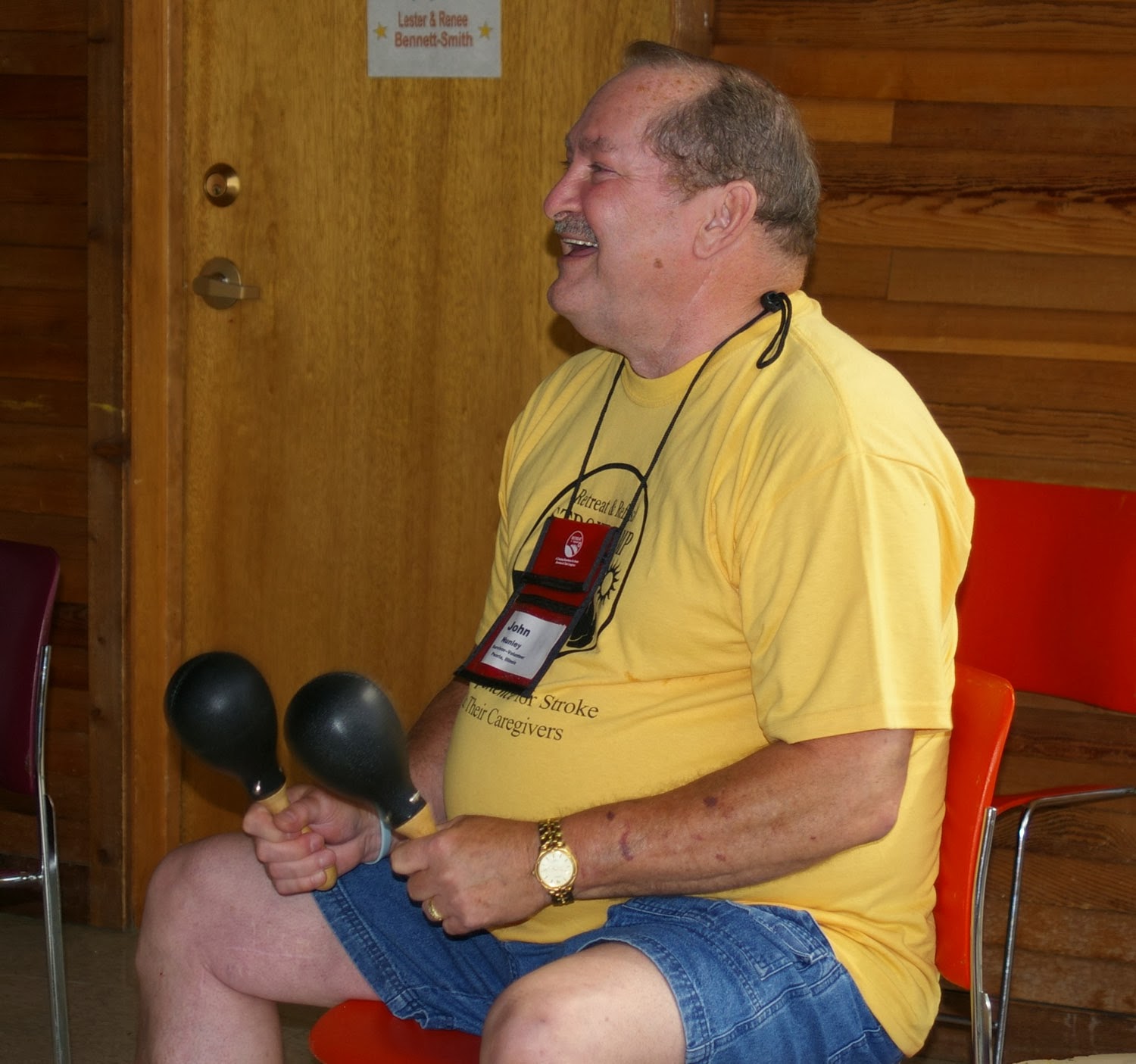
Marylee introduced me to her husband, John, who had survived his September 2001 stroke and was a friendly greeter.
I found myself observing more than interacting, but that was okay. I was still rather shy and felt much more comfortable listening and shooting photos.


 I saw caregivers and survivors of all ages,
from a young married couple to a mother accompanying her adult son who suffered a stroke after being shot in the head.

If I had seen most of these individuals while walking down the street, I would have never known they were survivors or caregivers. And each survivor faced different challenges, from physical deficits such as limited use of one side of their body to the inability to speak more than a few words.
The first clear message I heard was “once you’ve seen a stroke, you’ve only seen one stroke,” which I quickly absorbed and committed to memory.

And the second immediate lesson was that the simplest things in life are truly the most important … laughter, love, tears, holding hands, hugs, being oneself.

Marylee was definitely the hostess with the mostest as she made everyone feel at home in this main building that housed the individual sleeping and bathrooms for campers, and each opened into the main activity and dining room area.

Caregivers could sit in the main area and talk with other campers and volunteers while keeping a close eye on a sleeping survivor. What a perfect arrangement. I loved it.
To be continued.
Tuesday, December 24, 2013
Boy, Was I Ever Wrong - Monica.
By Monica Vest Wheeler


When I decided in 2008 to write a book on coping with stroke, several people told me I HAD to talk to some gal named Marylee Nunley. I had no idea who she was.
When Retreat & Refresh Stroke Camp executive director Marylee Nunley answered her phone in April 2008, she had no idea who I was. I identified myself as also being from Peoria and the author of a new book on coping with Alzheimer’s and co-author of an earlier volume on cancer. Now I wanted to write about stroke. Oh, and I wrote Peoria history books.
When I showed up at her house a week or so later, I immediately noticed a photo on the entryway wall. Marylee and I had a connection … other than both being short in stature. We had been honored in 2005 at a local event that recognized 25 women in leadership and were in the group photo. And on the magazine cover, my photo was below hers in the block of mini images. But we hadn’t actually met.
As we sat at her dining room table, I explained that I was focusing on brain-related topics for my book series, “Help Me Cope & Survive!” After working on the Alzheimer’s book for three years, I felt this “calling” to work on brain injuries, illnesses and diseases because brain topics often make people uneasy. Many equate any “abnormal” behavior to mental illness and shy away from people acting or speaking strangely. I had learned so much while working on the Alzheimer’s book that I wanted to address stroke, brain injuries, and brain tumors-brain cancer, all together in the next volume.
Marylee taught me more that day about stroke than I would have ever discovered in a typical classroom. Nope, I knew immediately that stroke had to be its own volume, as did the other topics. Her husband, John, had had a stroke in September 2001, and she was his caregiver. Marylee’s family knew more about stroke than 99.9 percent of the population as her brother’s wife, Meme, had had a stroke just two months earlier in February 2008.
After she briefly educated me on stroke, I asked her about this “stroke camp” I had heard about and why a number of folks had recommended I talk to her. With the enthusiasm of a mother talking about her newborn, Marylee told me about camp, a weekend experience for stroke survivors and their immediate caregivers. Hmm, I wasn’t the camping kind, but I’d love to talk to those who came to camp. I asked if I could attend for the day.
She said I could come as a volunteer at the first camp of the season in early June about 50 minutes from Peoria in Lewistown and talk to campers. Yeah, I had heard of Lewistown, but not this Living Springs campgrounds she talked about. Volunteer? Sure, why not. I had experience working with folks in my service organization. I filled out the form.
After thanking Marylee for her assistance, I headed home and put that date on my calendar. Sure, I could give up some time in June to get a bunch of interviews. Then I’d keep moving on with my research.
Boy, was I ever wrong.
To be continued …
w
************************************************************************************************************************
Sunday, December 22, 2013
Starting Christmas Eve
Starting Christmas Eve I will begin posting a series of articles written by Monica Vest Wheeler. As many of you know, Monica is very active with our stroke camp and with Alzheimers sufferers. She is also an accomplished writer with several books in publication. I am personally excited to see what she has to say in the upcoming weeks. I would also like to get offerings and ideas from the rest of you that I can interleave with Monica's future articles.
This blog has been in operation since December 2011. There have been 110 articles posted in that time and a page view count of over 17,600.
As blog moderator I have run out of ideas as to what to post next. What would you like to see or see more of? You can respond here by Comment or go to our Contacts link and use one of the contact methods listed there to submit your ideas.
Thank you for your readership this far and I hope we can continue with some thought provoking and interesting articles.
********************************************************************************
Sunday, December 8, 2013
Speech & Language Recovery - Bungalow Software
There are very few products I would care to promote on this blog but this product is one I think is very beneficial to stroke survivors having problems with speech.
We have demonstrated Bungalow's speech software at some of our camps and, Marylee, our camp Executive Director, speaks highly of it. She has used it with her husband John, who experienced a stroke in 2001. John started using several of the Bungalow modules daily in 2003 and Marylee saw dramatic improvement in his speech over the following two years. He went from barely speaking one word "sentences" to being able to carry on conversations in public.
I have mentioned this product in this blog before but I think it bears repeating.
I have taken the following off of the Bungalow web site to make it easy for you to access. However, if you wish to go directly to their site use this link: http://www.bungalowsoftware.com/
*********************************************************************************
We have demonstrated Bungalow's speech software at some of our camps and, Marylee, our camp Executive Director, speaks highly of it. She has used it with her husband John, who experienced a stroke in 2001. John started using several of the Bungalow modules daily in 2003 and Marylee saw dramatic improvement in his speech over the following two years. He went from barely speaking one word "sentences" to being able to carry on conversations in public.
I have mentioned this product in this blog before but I think it bears repeating.
I have taken the following off of the Bungalow web site to make it easy for you to access. However, if you wish to go directly to their site use this link: http://www.bungalowsoftware.com/
| |||||||||||||||||||||||||||||


Sunday, December 1, 2013
Once a Caregiver……and so Care Partners Resource was born.
I want to thank each and every one of you who voted for us on Facebook during the office makeover contest conducted by RK Dixon a market leader when it comes to copiers, printers, IT services and pure drinking water systems. We didn't win the $15,000 office makeover prize but, as a result of your efforts, the camp is a winner of a much needed $1,000 printer.
The following was published in the October/November RRSC NewsLetter. I'm reproducing it here for those of you who are not getting our newsletter. Feel free to click on any of Lori's links. They lead to some very helpful web sites.
Once a Caregiver…
by Lori Cavallo, VolunteerYou know the old saying “once a … Always a … “ I have found that to be true of the Caregivers I have met since I was introduced to the term 12 years ago. My mother survived a stroke which left her paralyzed on her right side and an expressive aphasic. All terms I had not heard before July 20, 2001. But after caring for her for eight years they now flow from my tongue like any other caregiver who has taken an active role in the recovery of a loved one. The moment I got the call my life and vocabulary were forever changed.
Like many caregivers I have taken my experience and am trying to make a difference in the world. I built a free website for caregivers (www.carepartnersresource.com) and I became certified to teach therapeutic
writing. I teach caregivers techniques to use their journal as a source of therapy and find solutions to their everyday caregiving challenges, with a heavy focus on writing a care plan that includes self-care. I have also become involved with National Stroke Association where I co-authored The Careliving Guide
(http://www.stroke.org/site/PageServer?pagename=careliving_guide) and helped start an online support group (http://careliving.stroke.org/) where caregivers help each other find resources or simply express their feelings so they are not isolated and alone.
Another way I try to make a difference is by volunteering at Stroke Camp. Marylee and John and everyone from Refresh & Retreat Stroke Camp are another example of taking the Stroke experience and turning it into a positive way to change the world. If you have gone to camp you know exactly what I mean and if you have not yet had the opportunity I hope to meet you at a camp next year.
Take your experience and make the world a better place. To read an article Lori wrote for StrokeSmart Magazine about camp, go to: http://www.strokesmart.org/new?id=164
********************************************************************************
DIRECTOR’S CORNER
by Marylee Nunley, Executive Director
though I wish I could. That is where our band of volunteers step in and execute camp weekends with professionalism, love, and dedication. It is a privilege for all of us to spend these weekends hearing stories of recovery, progress, accomplishments, and yes, frustrations and setbacks. Our campers have given me a rich knowledge of so many things that I otherwise wouldn’t know. It is my hope that everyone reading this, no matter what’s going on in your life, will take the time to focus on the good things and be thankful. And now read on and enjoy some things that our campers had to say this year!
"It was a very uplifting experience for us."
"What I liked most about Stroke Camp was how unselfish the
volunteers and staff were to me!"
"Such wonderful, nice, generous people to give of themselves to
help stroke survivors. They are angels."
"We had a great time all weekend. We were so glad we went. Thank you so much for caring about us!"
"I thoroughly enjoyed the weekend-the staff and people were
wonderful. It was an eye opening experience for me. Thank you to
everyone who worked to put this together."
"This was my 3rd camp and the best yet. I honestly believe you
could add the word “vital” to your list of adjectives. -- Thank you we had such a great time! It helped us look more easily into the future of our recovery."
"It was a wonderful, educational, entertaining and inspirational experience. Best weekend I have had post stroke."
"I liked the fact that everyone seemed happy to forget their
problems and just have fun."
"It was extraordinary far reaching and beyond!"
"We had an outstanding time. We tell everybody about the camp.
Will come back next year. Thanks so much."
"We didn’t know what to expect, but it was better than anticipated. It was a really great experience."
"Thank you-we had such a great time! It helped us look more easily into the future of our recovery."
********************************************************************************
Sunday, November 10, 2013
Think FAST
Here's a little reminder for you for the coming holidays. Holidays, especially Thanksgiving and Christmas, are the most stressful of the year. They are also the most indulgent involving food and beverages. Did you know that alcohol consumption is greater at Thanksgiving than it is New Years Eve or St. Patrick's Day? I know, hard to believe, but true! Stress, overeating, alcohol, shoveling snow, now there is an invitation to stroke or heart attack.
Please remember the following test shown below as you celebrate the coming holidays. You could save a loved one or even a complete stranger. Wouldn't that make your day?
If you see any of these symptoms, don't delay. There is nothing I can stress more than: DO NOT think these symptoms will go away and you'll be fine after all, and not go to the hospital. I have heard of a couple of instances lately, one in my own family, where the person had the symptoms, then felt them go away and thought they were ok only to have them come back the next day but even worse. Remember, when there is a blockage to your brain it is estimated that 1.6 million brain cells are dying each minute.
I think, in some cases, the person is afraid of the medical bill if the symptoms aren't really a stroke and insurance won't cover the expenses. Please don't take that chance. If you see these symptoms, you're having a stroke. Get to the hospital. I don't want to hear of you lying in a hospital bed unable to talk or move and you thinking, "Well, at least I saved $1,000 by not going in yesterday."
F.A.S.T.
[F] Face - Ask the person to smile.
Does one side of their face droop?"
[A] Arms - Ask the person to raise both arms.
Does one arm drift downward?"
[S] Speech - Ask the person to repeat a
simple phrase.
Is their speech slurred or sound
strange? Do they have trouble
understanding you?
[T] Time - Call 911 immediately.
Brain cells are dying quickly. It is
estimated that 1.6 million brain
cells die every minute after blood
flow is cut off.
Please remember the following test shown below as you celebrate the coming holidays. You could save a loved one or even a complete stranger. Wouldn't that make your day?
If you see any of these symptoms, don't delay. There is nothing I can stress more than: DO NOT think these symptoms will go away and you'll be fine after all, and not go to the hospital. I have heard of a couple of instances lately, one in my own family, where the person had the symptoms, then felt them go away and thought they were ok only to have them come back the next day but even worse. Remember, when there is a blockage to your brain it is estimated that 1.6 million brain cells are dying each minute.
I think, in some cases, the person is afraid of the medical bill if the symptoms aren't really a stroke and insurance won't cover the expenses. Please don't take that chance. If you see these symptoms, you're having a stroke. Get to the hospital. I don't want to hear of you lying in a hospital bed unable to talk or move and you thinking, "Well, at least I saved $1,000 by not going in yesterday."
To Identify Stroke Symptoms
Remember This Simple Lifesaving Test
F.A.S.T.
Does one side of their face droop?"
[A] Arms - Ask the person to raise both arms.
Does one arm drift downward?"
[S] Speech - Ask the person to repeat a
simple phrase.
Is their speech slurred or sound
strange? Do they have trouble
understanding you?
[T] Time - Call 911 immediately.
Brain cells are dying quickly. It is
estimated that 1.6 million brain
cells die every minute after blood
flow is cut off.
Sunday, November 3, 2013
We Need a $15,000 Office Makeover
If you are on Facebook you most likely know about this already. For those of you who are not, here's what we have a chance to qualify for, and you can help us by doing two simple clicks.
Now in its 8th year, the Make My Non-Profit Run Better contest offers non-profit organizations the chance to win an office makeover that will help them run better. The Make My Non-Profit Run Better contest is organized by RK Dixon.

You can vote once every day until Nov 8th 5pm from any internet connected device and you can vote each day from as many different devices as you have access to. For instance, if you have an iPad, a desktop computer and a laptop computer you can vote from each one once a day. That give us a total vote count from you of 3. How great is that?
The top winning organization will receive an office technology makeover valued at up to $15,000. The first runner-up will receive a multi-function printer selected by RK Dixon and Premier valued at up to $10,000. The three remaining winners will receive a multi-function printer selected by RK Dixon and Premier valued at up to $5,000. In addition, we will award 10 runners up with printers valued at up to $1,000 each.
There is no purchase necessary to enter or participate. This contest is their way of thanking our organization for the work we and you do in the community.
We have already obtained enough votes to make it to the final round. There are now 25 finalists left in the contest and we are one of them. The 25 finalists will be narrowed down to 5 by Nov. 8, 2013 through this second round of online voting. The second round of online voting is taking place Nov. 1 at 8 a.m. – Nov. 8, 2013 at 5 p.m. RK Dixon and Premier will select a winner from those five finalists and announce the name of the winning organization on Nov. 20, 2013.
Prize: RK Dixon and Premier will assess the needs of the winning organization and then provide an office makeover valued at up to $15,000.The top winning organization will receive an office technology makeover valued at up to $15,000. The first runner-up will receive a multi-function printer selected by RK Dixon and Premier valued at up to $10,000. The three remaining winners will receive a multi-function printer selected by RK Dixon and Premier valued at up to $5,000. In addition, we will award 10 printers each valued at up to $1,000. No more than 25 percent of the $15,000 makeover may be allocated towards IT solutions.
Now in its 8th year, the Make My Non-Profit Run Better contest offers non-profit organizations the chance to win an office makeover that will help them run better. The Make My Non-Profit Run Better contest is organized by RK Dixon.
Click on the below icon and vote for Retreat & Refresh Stroke Camp by clicking the VOTE box located next to our name. We are listed at the bottom of the Blue Zone:
You can vote once every day until Nov 8th 5pm from any internet connected device and you can vote each day from as many different devices as you have access to. For instance, if you have an iPad, a desktop computer and a laptop computer you can vote from each one once a day. That give us a total vote count from you of 3. How great is that?
The top winning organization will receive an office technology makeover valued at up to $15,000. The first runner-up will receive a multi-function printer selected by RK Dixon and Premier valued at up to $10,000. The three remaining winners will receive a multi-function printer selected by RK Dixon and Premier valued at up to $5,000. In addition, we will award 10 runners up with printers valued at up to $1,000 each.
There is no purchase necessary to enter or participate. This contest is their way of thanking our organization for the work we and you do in the community.
We have already obtained enough votes to make it to the final round. There are now 25 finalists left in the contest and we are one of them. The 25 finalists will be narrowed down to 5 by Nov. 8, 2013 through this second round of online voting. The second round of online voting is taking place Nov. 1 at 8 a.m. – Nov. 8, 2013 at 5 p.m. RK Dixon and Premier will select a winner from those five finalists and announce the name of the winning organization on Nov. 20, 2013.
Prize: RK Dixon and Premier will assess the needs of the winning organization and then provide an office makeover valued at up to $15,000.The top winning organization will receive an office technology makeover valued at up to $15,000. The first runner-up will receive a multi-function printer selected by RK Dixon and Premier valued at up to $10,000. The three remaining winners will receive a multi-function printer selected by RK Dixon and Premier valued at up to $5,000. In addition, we will award 10 printers each valued at up to $1,000. No more than 25 percent of the $15,000 makeover may be allocated towards IT solutions.
Please help us and THANK YOU for your help.
Subscribe to:
Posts (Atom)