Sunday, June 24, 2012

Jan's Journal Part 2 - Stroke Diagnosis and Treatment

by Jan Jahnel

Jan Jahnel RN, CNRN is the Stroke Nurse Coordinator for the INI Stroke Center and INI Stroke Network at OSF Saint Francis Medical Center in Peoria, Illinois. Jan has 14 years of neuroscience nursing experience with the last five years focusing on stroke processes and care. Her commitment and dedication has been an important part of Stroke Camp. She works very closely with Retreat and Refresh Stroke Camp, attending many weekend camps, helping with some of our fund raisers, and providing us with technical knowledge about strokes. 


                                       Stroke Diagnosis

The diagnosis we're covering here is that which comes after the stroke survivor has entered the hospital. I am assuming you already know the F.A.S.T. and the "Give Me 5" method from Part 1 for telling if someone is experiencing a stroke and that you have rushed immediately to the hospital within three hours of the first symptom. 

Once in the hospital, it is critical for the medical personnel on site to diagnose the stroke in progress. Timing is very important. 

                     Time lost is brain lost!! 

That is why timing is so important. Time lost is brain lost.  It is important to quickly recognize, diagnose and treat the stroke while it is happening.

                       Types of Diagnosis

* CT-or Cat scan is a key test. It is usually the first test given to
   patients with stroke symptoms. Determines whether there is
   bleeding in the brain. 

* Angiography- groin area puncture with dye injected into the 
   vessels. This gives a picture of the blood flow to the brain. It will 
    show size, location of blockage, aneurysms and malformed    
    blood vessels.

* Carotid doppler- this is an ultrasound of the neck vessels to 
   assess for narrowing of the neck vessels. 

* Echocardiogram- ultrasound of the heart assessing for

   problems with the heart or poor pumping action. 

* MRI –like the cat scan it produces an image of the brain. This 
   image is used to diagnose small deep injuries. 

* Lab work-up – This helps determine other possible causes for 

   ischemic strokes. 


                                   Acute Stroke Treatment

MERCI device- FDA approved device: catheter with a small corkscrew device that grabs the clot. The Merci device is a catheter that is threaded up through the vessel to the clot.  Then a small corkscrew device is threaded through the catheter and into the blood clot.  The corkscrew device and the clot are then pulled back into the catheter and out of the blood stream

Penumbra device- FDA approved device: a catheter with a separator and a vacuum that separates the clot into small pieces that are then vacuumed into the catheter. 


Intra-arterial t-PA: t-PA is injected directly at the site of the clot. This also involves taking the person to have an angiography.  The catheter is threaded up to the clot site and the medicine is injected directly at the clot.


The only FDA approved acute drug treatment for an ischemic stroke is IV t-pa (ischemic stroke are those strokes caused from a blocked vessel). Time is also important for determining treatment for strokes. This drug must be given within 180 minutes of symptom onset.  Symptom onset is the last known time the person was “normal”. This means the person must get to the hospital, obtain a CT scan and have the medication available. Strict guidelines are used to decide if a patient qualifies for this treatment. Many factors may disqualify a patient from receiving this treatment. It cannot be given to everyone, especially for hemorrhagic strokes, (those strokes caused from bleeding into the brain.) Complications with IV t-pa include hemorrhage in the brain so patients receiving IV t-pa will be in the ICU for at least 24 hours with hourly assessments.


                        Treatment for Hemorrhagic Strokes 

Intracerebral hemorrhage-There is no approved acute drug treatment for a hemorrhage in the brain.  The doctors will want to keep the blood pressure controlled and not let it get too high.  They may administer blood products such as plasma or platelets to help the blood clot especially for those on any type of blood thinners. Surgery or catheters (Ventriculostomy) may be used to drain or remove fluid and blood from the brain.


                                                   Aneurysm Treatment


There are two types of treatment available for strokes caused by an aneurysm rupture; 


Endovascular Coiling - A tiny catheter is threaded from the groin artery up into the brain artery and into the aneurysm. Tiny platinum coils are released into the aneurysm to seal it off. Endovascular treatment originated in the 1980’s by an Italian physician Dr. Gugleilmi.  With the origination of this new treatment some patients who were told the aneurysm was inoperable now have hope for a treatment. Other patients because of advanced age, medical condition, or other factors who could not tolerate open brain surgery this could be an alternative to their treatment.
Clipping - Surgical Clipping is still the most common surgical treatment for brain aneurysms.
This requires general anesthesia, incision into the skull and removal of a section of bone.
Under a microscope the aneurysm is carefully separated from the normal blood vessel, it is then clipped with a tiny clip somewhat like a clothespin. With the clip in place no more blood can enter the aneurysm.
                                  

That's it for Part 2. I hope this was not too technical, but I did find it interesting and thought it was worth passing on to you. Next, in Part 3, I'll cover what the stroke survivor can expect from the Brain Attack and what will happen after being admitted to the hospital.


Monday, June 18, 2012

Marylee's Top 10 Stroke Tips for New Caregivers


I have been a caregiver for my husband, John,  who had a stroke over ten years ago, but recently, through unfortunate circumstances, I was reminded of the things a caregiver learns as they navigate the early years following a stroke.  This reminder came after my brother’s wife had a massive stroke.  While he was getting through the first few months, he leaned on me as the “stroke expert” asking questions almost daily. As a caregiver for my husband, John, I realized we were settled in a rhythm and I had forgotten all the ways that we adapted after his stroke.  I’ve worked with many stroke survivors and caregivers as executive director of Retreat & Refresh Stroke Camp, so decided to do my “Top Ten List” for new caregivers.  Although each stroke is different, whether it is one month or ten years post-stroke, these are some things I personally have found to be true.

  1. Routine is your new best friend.  Give your survivor adequate information about any changes as soon as possible.
  2. Don’t try to reason with a survivor having a melt down. They are simply not able to be rational in the moment. Remember it’s the stroke, not you that makes them angry or sad.
  3. Always, I said always, keep calm in a crisis. Deep breathe and count to 10 (or 100 if necessary).
  4. Don’t take the exit of friends and family personally.  It is their issue, not yours.
  5. Slow down and repeat things with great regularity. Look at your survivor when talking with them (whether or not they have aphasia, they may have memory and cognitive challenges that require more attention to the conversation). 
  6. Encourage your survivor to get as involved as possible in decisions involving their care or family situations.  They still need a voice and to feel they are a part of life’s decisions.
  7. Allow acceptance that some things will always remain your responsibility.  (Paying bills, managing medications, overseeing doctor’s appointments, meal planning, cooking, household tasks, communicating, etc.)
  8. Find your “new normal” and seek a few things that you both enjoy and then participate. (Go to the mall and walk or wheel around, get a bite to eat or a gourmet coffee, watch the people, then go home and rest.  Attend reasonably priced community theater, go to a park and watch the people as you feel the wind on your cheeks. Sit on the front porch rather than in the house, go to a support group, volunteer both of you or even independently to do something for someone else).
  9. Accept that it is unlikely you will ever have a normal “marital” or “family” disagreement that will be resolved in the moment. Things that need to be addressed or changed will better come through planned discussions, one topic at a time.
  10. Never ever give up because there can be progress even many years after a stroke.  The progress may not be dramatic, but it’s there.

I hope you find some of these tips helpful on your own personal journey following a loved one’s stroke.

Marylee Nunley, Executive Director, Retreat & Refresh Stroke Camp and wife of John Nunley, survivor since 2001.

Sunday, June 10, 2012

Jan's Journal Part 1 - About The Brain

by Jan Jahnel
Jan Jahnel RN, CNRN is the Stroke Nurse Coordinator for the INI Stroke Center and INI Stroke Network at OSF Saint Francis Medical Center in Peoria, Illinois. Jan has 14 years of neuroscience nursing experience with the last five years focusing on stroke processes and care. Her commitment and dedication has been an important part of Stroke Camp. She works very closely with Retreat and Refresh Stroke Camp, attending many weekend camps, helping with some of our fund raisers and providing us with technical knowledge of stroke. 

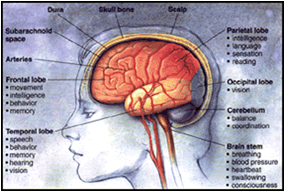
The following is a Power Point presentation she has provided that explains many of the technical aspects of a stroke. I have modified it and converted it to a multi-part series in blog format.  (Please forgive the blurriness of the first picture. It's the best I could do during the conversion from Power Point to blogger format)   


 In this picture you can see the different lobes of the brain.  It also shows some important areas within those lobes, such as speech areas, vision areas, and areas for reading and comprehension.  Damage to these specific areas will result in difficulty with speaking, understanding what is being spoken, problems with vision, and balance.                                      

The left side of the brain controls the right side of the body, language centers and logical thinking.

The right side of the brain controls the left side of the body, recognition and sensory/spatial perception.

With the brain, the right side of the brain controls the left side of the body and vice versa.  The right side of the body (arm and leg ) will be affected with a left sided stroke.  The left side of your brain also controls logical thinking and your language.
The right side of the brain is responsible for vision and recognition. It also controls the movement and sensation of the left leg and arm.   The brain is a very complex and important organ.  Any interruption to the normal functioning of the brain can cause many problems.
                     
                                           Brain Attack
Strokes happen in the brain. The “Brain attack” term is used to show that a stroke is as serious as a heart attack. Lack of blood supply to the brain results in damage to the brain tissue causing injury to the brain.  Without adequate blood supply the brain tissue dies. Stroke symptoms will depend on the size of the stroke, the location and vessel in the brain that is injured. 

                                        Stroke Symptoms


                                          Types of Strokes
                                           - Ischemic
                                           - Hemorrhagic

 
There are two types of strokes. If you think about stroke as a plumbing problem an ischemic stroke occurs when the pipe gets clogged and a hemorrhagic stroke occurs when the pipe bursts.

                                          Ischemic Strokes


Here are some examples of how the pipe can clog.  An atherosclerotic clot is caused by fatty plaque buildup in the vessels.  These fatty deposits stick to the vessel wall and caus narrowing, slowing down the flow of blood. As these fatty plaques build up, the vessel looks at this as an injury and sends out cells to repair itself.  This causes a clot to form and either stops the blood flow to the brain or the clot can break away from the vessel wall and travel to the brain.  This is called a thrombotic stroke
A blood clot that travels to the brain is called an embolic stroke.  These are usually caused by a wandering blood clot, usually from the heart or the neck vessels.  Atrial Fibrillation( which is an irregular heartbeat) or a PFO ( which is a small hole between the chambers of the heart) may be the reason these clots form and are carried in the blood stream, clogging the vessels leading to the brain.
When this happens blood supply to that area of the brain is cut off and brain injury occurs.


                                       Hemorrhagic Strokes

Another type of stroke is called a hemorrhagic stroke.  This is when the pipe or vessel bursts and blood is spilled into the brain.  This is a CAT scan picture of bleeding into the brain.  The white area shows where the bleeding has occurred.


An arteriovenous malformation is an abnormal cluster of arteries and veins all tangled together.  These tangled vessels in the brain can rupture and bleed, causing a stroke.


                                                Aneurysm
A weakened area or a ballooning of a vessel wall


An aneurysm may happen in an area of the vessel where it splits….kind of like a T in the road.  The blood vessel weakens and the vessel wall balloons at the split.  The aneurysm can grow very large.  The walls of the aneurysm become very thin and finally ruptures spilling blood into the brain.  This is called a subarachnoid hemorrhage.


Cause of Hemorrhagic Stroke
    Long standing Hypertension: High blood pressure that is not 

    controlled adequately. There are some reasons why the pipe  
    bursts.  Long standing high blood pressure that has not been 
    controlled can weaken the vessels over time and cause them to 
    leak or burst.


I hope this gives you a little insight of what a stroke is and a little idea of what the brain looks like and its many functions. In the near future I will be covering other topics such as some diagnostic tests stroke survivors will experience in the hospital and different types of treatments while there, what stroke survivors may expect while in the hospital and later when released, managing risk factors, rehabilitation, and what support is available after the survivor has been released from the hospital.

Sunday, June 3, 2012

5th Grade Education

Lindsay Kwok's Grand Prize Winning Poster
 Retreat and Refresh Stroke Camp recently completed its fourth year of doing stroke education in fifth grade classes in and around Peoria, IL.  This year we visited nine schools and spoke to 25 classrooms.  That is a total of about 650 fith grade students and teachers who now know more about stroke than the average American does!

The classes run between 45 minutes and an hour each and have multiple components.  We start by introducing everyone - nurses, students, stroke survivors/caregivers, etc...  Then we ask how many of the students know someone who has had a stroke.  You would be shocked by the number of hands that go up!  Many of the students have stories to tell about how their grandma/pa, aunt, uncle, etc... who have had strokes.  However, not many students know the warning signs and symptoms of a stroke.

That's where our nurse/s or nursing students come in!  They teach the students about what a stroke is, the different kinds of stroke, and two different ways to tell if a person is having a stroke.  Do you know all the warning signs and symptoms??

We teach them to "Gimme 5":

1. Walk - Can the person walk? Do they walk funny or stumble?
2. Talk - Is the person able to talk normally?  Do they understand what you are saying?  Do they
    mumble or talk gibberish?  Do they have slurred speech?
3. Reach - Are they able to reach up with both arms and hold both arms up for 10 seconds?  Does one arm  start to drift downward?
4. See - Do they have double vision?  Do they have tunnel vision?  Can they only see on one side?
5. Feel - Are they experiencing tingling or numbness, particularly on one side?  Do they have the
    worst headache of their lives?

We also teach them to act F.A.S.T.:

F - Face-ask the person to smile.  Do both sides of their mouth go up?  Or does one side droop?
A - Arms-ask the person to hold up both arms for 10 seconds with their eyes closed.  Does one arm
      drift or fall downward?
S - Speech-ask the person to repeat a simple sentence.  Are they able to correctly repeat the
      sentence?  Do they mumble or sound like they are speaking a foreign language?  Do they
      understand what you are asking them to do?
T - Time. If ANY of these are not right, call 9-1-1 IMMEDIATELY!  Don't let them take a nap and
      hope it will get better and don't wait to call the doctor.  They need immediate medical attention.

Time Lost = Brain Lost.

We emphasize with the students that a stroke can happen to anyone at any age of any race or ethnicity, although the risk increases with age. 

Then we have our stroke survivor and/or caregiver tell his/her stroke story.  The students always have some really great questions for them.  A common question is: What does it feel like to have a stroke?   After that, the students each participate in one disability simulation where they have to complete a task using only their non-dominate hand.  Tasks include things such as putting on and fastening a belt, putting on and buttoning a button down shirt, putting on a sock and shoe and tying the shoe, folding laundry, packing a book bag for school and zipping it, etc...  The students learn very quickly that completing these tasks with only one hand takes longer than usual and they have to be creative (adapt) in order to be successful.  The take home message is that stroke survivors are not dumb and they are not stupid!  They just might be slower at things because the stroke has effected their brain and possibly their motor coordination.

Collin Stratton's runner-up poster from Peoria Christian Middle School.  
We also teach them about prevention: eat healthy, exercise, and DON'T SMOKE!  Each student is given a poster and is instructed to create an educational poster about stroke.  We judge based on content, accuracy (spelling counts!), neatness, and creativity.  Our panel of judges selects the top three posters from each class and those students each get a gift card to Wal-Mart (a big thank you to the Pilot Club of Peoria for donating toward the gift cards).  The grand prize winner gets to ride in the Life Flight helicopter and land in center field at the Peoria Chiefs game on our Strike Out Stroke day-June 10, 2012!!!  All winning posters will be displayed on the O'Brien Field walls at the game on the 10th.

We would like to thank the Illinois Neurological Institute, in particular nurses Jan Jahnel and Teresa Swanson-Devlin for helping with and sponsoring these education classes since their inception.  We would also like to thank Jordan Jason and Kendra Zerwekh, students from the Methodist College of Nursing, who helped at some of the schools this year.  Without the assistance of INI and Methodist, these classes would not be possible.

Sunday, May 27, 2012

Stroke Specific Things I Wish I’d Known Sooner


by Marylee Nunley

v  Hearing early on (in a kind, gentle, and positive way) that this is a permanent condition, but still not to lose sight of great possibilities. To be informed that recovery takes lots of time and patience by all.

v  The brain is injured and it may take up to six months for it to heal and recover.  After that time, the patient will be working with the undamaged parts of the brain through a lengthy but rewarding relearning process.

v  Understanding that each time there is a new environment, the survivor may need to re-learn things (shower at home different from the hospital, bed not as convenient, meals served differently, etc.)

v  How to find the handbooks from www.strokenetwork.org  (online support group) or www.stroke.org (NSA) at the onset.  The internet and Facebook is full of things that help families understand the different parts of care and rehab that will be happening. 

v  Being given a list of stroke specific  terminology

v  Stroke survivors may seem to understand way more than they actually do. My impression was that if he heard it, he understood just like I did.  That couldn’t have been farther from the truth.  Receptive aphasia means that the person with the brain injury doesn’t hear and process the words the way they are spoken and may not understand what is said or completely misunderstand what is said.

v  Progress will be in terms of months and years and for the rest of your life, not in just days and weeks.

v  More about the caregiver role and what will be expected once going home and about burnout.  No matter how much energy and commitment we have, there will be a time we’ll just get tired of the responsibility.

v  More about aphasia----look at the person, go very slowly, that even though they hear what you say, they may not fully understand.

v  Support groups—both survivors and caregivers need them.

v  What to look for with regard to depression (often comes out as anger or crying) from isolation and loss of parts of their life

v  Understand how frightened the patient is and how lost they are in the world and may not understand what’s really going on

v  Routine should become your best friend for awhile

v  ADL equipment, gadgets and gizmos.  There isn’t time for the medical community to provide all this information and they don’t have the means (financially, insurance runs out) short of funding of some sort of program following discharge.  Here is where support groups can help

v  Understanding Health Benefits can be a challenge and making friends with a good social worker, discharge planner, or the insurance billing clerk can’t hurt

v  Disability application is long and tedious. There are books that can help. Make the adjudicator your friend and follow through with their requests

Well, that's my list. Undoubtedly you will have other items 
that you've encountered. If you want, go ahead and share
them by leaving a comment. That way we all learn just that
much more.  

Sunday, May 20, 2012

I’m not a stroke survivor. What am I doing here?

by Chuck Jones

I get asked at almost every camp why I’m volunteering my time and “muscle” for Retreat and Refresh Stroke Camp. What is my connection with strokes or the camp? Why am I attending these camps? I haven't had a stroke. I don’t have a relative Survivor attending these camps as most do. There has been at least one stroke survivor in my family history but that was a long, long time ago. I am not an employee of any medical institution that works with stroke survivors. So, why am I here?

To explain my interest, I always start out with a short history of my association with John and Marylee.  For you, I will go into more detail. And really, this is not about me, primarily, but about Marylee and John Nunley, the founders of this camp.
  
As you may know John and Marylee Nunley are the founders of Retreat and Refresh Stroke Camp, founded in 2004. I am friends with both and I started out helping on camp weekends on Saturdays only. At that time, there was only one Stroke Survivors camp a year at the Living Springs Camp Ground near Lewistown, Illinois. Lewistown is about 45 miles south west of Peoria, Illinois.  John and Marylee live in Peoria.  Why did the camp start out at Living Springs Camp Ground in Lewistown 45 miles away? Well, that could be a topic for another blog article…some day.
    
John and I both worked at Caterpillar, Inc back in the 70’s. I'm not sure when John started at Cat but I started in 1970. John started out in Joliet, Illinois, which is about 128 miles north of Peoria and I started out in East Peoria, Illinois -  the Heart of  Illinois - which is about midway between Chicago and St. Louis.  John started in the factory and worked his way up into computers and finally ended up in Caterpillar’s Information Services Department in East Peoria in building AD.  I started out in computers in building A, in East Peoria, in May 1970, as a Tape and Disk Systems Programmer. Yes, we actually used tape in those days. Also, punched cards that contained our program code. I don’t remember exactly when John and I met but it was in building AD in East Peoria after it was built in 1979 to house Caterpillar’s Corporate Information Services staff. John and I, if I remember correctly, ended up in Database Application Support together in that building, supporting similar applications. So that’s how I met John.

We parted ways for a few years as departments fragmented and permutated but, eventually, John and I ended up together again in the IMS Database Support section. John has a commanding knowledge of computer application languages and IMS databases. IMS is a hierarchical database product developed by Caterpillar and IBM back in the 60’s. (okay, wake up. I didn't mean to put you to sleep) I will tell you, if I had my own Database company, I would need only one John to have a successful business (well, maybe two, because one thing I've learned in the computer business, it’s always prudent to have a backup).

John married Marylee in 1996, and in January of 2001 John began to have a series of medical complications with pancreatitis. During that terrible time I coordinated the IMS team, and others who knew John around Cat, to provide visiting and other needs, such as grass cutting, leaf raking, etc. to help them. Those who have met John know how much a likable person he is. He has a lot of friends at Cat who were willing to help him and Marylee through such tough times. John was well on the way to recovery from pancreatitus when in September of 2001 he had a stroke. If you are involved with a stroke survivor in any way you know what that means.
  
Against her wildest dreams of how she saw John and her future unfold after their marriage, Marylee became involuntarily involved in the stroke survivor recovery process. She immediately noticed several shortcomings involved in that process. Who provides an environment where a survivor feels like a person again? Where can a survivor feel something like normal again, if only for a weekend? Marylee, being the person she is, decided there was a need for something like that and maybe she could do something about it. She and John had some past experience with running a camp for children so they decided to give it a try for stroke survivors.
   
Marylee, and her sister Sarah and her husband Boyd, had previous experience with running camps for kids with Cystic Fibrosis (thus the connection to the Lewistown location) so her logical conclusion was, why can’t this work with stroke survivors? Okay, if you’re still with me, you won’t find it too difficult to see how the now current camps evolved.

That’s the detailed history lesson I promised. Today we’re looking to have 25 camps a year plus a few MegaBrain exhibits thrown in for education. I don't know about you but to me that is some awesome growth! If you want to know more about the MegaBrain click on February in the Archives area to the right of your screen.

Now the reason for this blog article - Why am I involved? As I stated earlier, I began because of my friendship with John and Marylee. After attending a couple of these camps I was able to see how much of a positive effect the camp had on the well being of the survivors AND their caregivers. Not only the camp as a whole, with themed activities, crafts, and fun and games, fishing, and rock climbing, but what impresses me the most is for an hour or so all the survivors get together in one room and all the caregivers gather in another to share their progress, hardships, experiences, encouragement, and hope. And you wouldn’t believe the benefits, emotional healing, and hope that leaves those two rooms.

I'm proud to be a part of that.

Sunday, May 13, 2012

Attention Volunteers

by Chuck Jones

Hey gang, this posting is for all you volunteers:

I've decided that if I wait until our camp volunteer schedule is complete it would never get sent, so now it is ready.  You each should have gotten a copy in your email. It has been quite the difficult task as we attempt to match our volunteers with their "gifts" and still try to be sensitive to schedules hoping there are no hurt feelings in the process.  There are still some gaps that we are working to fill and some new people we are planning to train.  As is typical, there will likely be some changes before we execute the camps.  Someone will get sick or have a family situation come up, but at least we'll have a working document and you can put some things on your calendars. The question marks that you will see in the spread sheet I emailed to you are things that are pending due to information we need from our sponsors which will be confirmed when we get final word from them.

For those of you who might not have heard, Monica Vest Wheeler and Roger Wheeler are donating a trailer suitable for transporting our equipment to camps when there are double camp weekends.  More on that later, but that's why you see the column in the spreadsheet designating Van or Trailer.

You may notice that the Murray, KY camp isn't listed.  It's because they have decided to merge with the other two hospitals and will now become the "Western, KY" camp.  You will also see a couple of MEGA Brain dates listed.  That is because they coincide with a camp weekend and we want to be sure we cover all the activities that are happening.

Our meetings in Florida went very well and there are three hospitals in the Sarasota area who will be talking about partnering to bring a camp to their area.  They were receptive to an October date if they can get the funding.

Please know that we greatly appreciate all that you do for the camp and for our survivors and caregivers.  What you are doing is amazing and as you know, we couldn't do it without you. 

Marylee and John

Sunday, May 6, 2012

Just Waiting and Planning

by Chuck Jones

Resting, planning, preparing, recruiting. That's where we are this month of May with our Stroke Camps. We have no camps scheduled for May but we have two camps coming up in June and both of them are on the same weekend. Now, how did that happen? It's easy. Campsites are not easy to schedule and book. There is a big demand for these sites from all over the country by all different organizations. We are just one of many.

We must book a site a year in advance to secure one and we must make a substantial deposit to hold that site for the year. This deposit is at risk because how can we book a site if we don't know if there will be a sponsor or even if campers are available? Well, you begin to appreciate our challenge. Basically, we have to get a commitment from a sponsor and take whatever campsite is available after that.  Keep in mind, these sites must be comfortable and handicap friendly for our stroke survivors.


This is one of the sites we were able to book last year near Lincoln, Nebraska.


We must find sponsors around these fifty states, meet with them, and obtain a commitment. Our financial resources are very limited so we can't schedule a camp without this commitment from a sponsor. We also work with these sponsors to identify potential campers. At the time of this writing our sponsors have been hospitals and other medical institutions. They operate as a business as we do so they have a budget just like we do, only on a different scale, of course. Nevertheless, we have to get on their budget in order to get funding before we can even begin booking one.

You might ask how we find campsites. That is a challenge in itself. We do a lot of searching ourselves to identify viable sites. Some recommendations come from the sponsors or by interviews with their staff. The internet is a useful tool for this, also. State Parks and Recreation sources are good places to start. When a list of site candidates is developed the sites must be visited by our team to ensure they meet our standards.

Doesn't that take a lot of traveling to meet with sponsors and visit campsites, you may ask. Oh, yes. We have very dedicated people who do this and do this without any fanfare. This is one of the things that make our camps great. It's the people who are dedicated to help make the life of someone else better, even if it is for only one short weekend a year.

Please feel free to post any comments or questions by clicking on the red word Comment following this article. If you have any questions or comments about anything that you would like to share with us please feel free to do so on any of our articles. Don't worry about being off topic. Any question or comment is welcome on any of the article's comments section.

Sunday, April 29, 2012

The Season Has Begun and Our Thank Yous Have Started

by Chuck Jones

We are very excited to kick off the camp season! Chicago, Rockford and Denver campers and volunteers, if you haven't signed up for camp, please do so soon!
What a way to start the 2012 camp year! We had a great time at Camp Courageous in Monticello, IA, April 20-22, thanks to our incredible sponsors University of Iowa Hospitals and Clinics, St. Luke's Hospital and Mercy Medical Center. Here's our official camp photo. Looking good everybody! Camp photos will be posted shortly on the photo gallery section of our website www.strokecamp.org Enjoy!


Our first camp of the season was at Camp Courageous in Eastern Iowa, April 20-22. Attendance was around 48 campers, including volunteers. The report I got was that it was a great success. This camp had a rock wall for climbing and a warm water pool for that low impact aerobics and general floating around. The theme for this year for all the camps is Cruisin to Stroke Camp, with all the fun things that happen on a cruise, complete with costumes, Captain's Dinner (served by a real chef, Chef Dennis), Stroke Camp Casino, Karaoke, balloon animals and even a stand-up comedian (unlucky volunteer in the wrong place at the wrong time?). This camp was sponsored by St. Lukes Hospital, Cedar Rapids, Mercy Medical Center, Cedar Rapids and University of Iowa Hospital and Clinics. THANK YOU Cedar Rapids!


The van was back at the "warehouse" in Peoria for unloading last Tuesday after the Iowa camp. Did you notice the quote marks around warehouse? That's because Marylee's mother, whom we all affectionately call Granny, has been letting us use her garage to store all our camp items. And they fill her garage to the brim. Someday, she'll want her garage back, I imagine.  THANK YOU Granny! You are so patient with us, and we love you very much!

One of our volunteers, Monica Vest Wheeler brought a set of very sturdy yet lightweight aluminum ramps we will be able to use for loading and unloading large containers into the camp van. THANK YOU Monica! We tested it out last Monday on a large, heavy container and saw that it will, indeed, save a few backs this season.

Please be sure to listen to Larry Schaer and Marylee Nunley on the "In The Neighborhood" radio show. It is a radio show that they were on a few months ago, but you can access the recording through the following link. Check it out! http://www.peoriaarea.com/rr-stroke-camp.htmlYou'll have to endure a short commercial at the beginning but the interview is well worth the wait. This is an excellent interview and well worth the listen.

We have another addition to our internet presence now.  A new web site for our chimes Choir that is still in its infancy, so check it out from time to time for updates. Go to: chimestrokers.org.  

What else do we have and coming up soon? Our next camp will be in Elmhurst, IL,  June 22-24 at the Elmhurst College dorms, sponsored by the Alexian Brothers Health System. And on this same weekend we also have a Rockford camp going on in Oregon, Ill. at the Lutheran Outdoor Ministry Center. It is being sponsored by OSF St. Anthony Medical Center, Swedish American Hospital, Rockford Health Systems, and Van Matre Healthsouth Rehab Hospital. 

The next scheduled ELSIE and her Megabrain exhibit will be at the Arizona Diamondbacks game in Phoenix, May 26th.  I originally thought we were going to have more MegaBrain exhibits at ball diamonds this year but it turns out some that I thought were going to be MegaBrains were "Strike Out Stroke" theme only. Keep up to date on ELSIE and her Mega Brain exhibits by following the "Calendar of Events" link at the left of your screen.

That's it til next week. Be safe and remember stroke survivors never quit!

 Please feel free to post any comments or questions by clicking on the red word Comment following this article. If you have any questions or comments about anything that you would like to share with us please feel free to do so on any of our articles. Don't worry about being off topic. Any question or comment is welcome on any of the article's comments section.

Random thoughts

by Chuck Jones

This blog has been up and running since Dec 20, 2011. In that four month period we have had over 1,500 page views.  Not so many comments though. I would like to thank those of you who have visited us and I hope you found some value in what we have offered so far.

I’m very interested in knowing what you readers think of this blog. Are we covering the kind of things you are interested in? Are there other stroke related topics that you would like to see posted here? 

This year we will be having a very busy schedule for our camps. If you look at the links on the left of your screen you will see one for “Stroke Camp Dates”. Follow that link and you’ll get the exact dates. So far we have 18 confirmed camps scheduled for 2012, with more on the way. We are expecting 25 before the year is out. We actually have four weekends where two camps will be going on simultaneously. The camps will start out in April in Iowa and progress through Illinois, Florida, Colorado, Missouri, Kentucky, Nebraska, Arizona, and end the year in October in Odessa, Texas. Yes, that’s a lot. We are also working to have camps for Omaha, Nebraska, Savannah, Georgia, Wilmington, North Carolina and Houston Texas.

Not only are we conducting these camps but we also started to display ELSIE and her MegaBrain this year around the country. You may have read about that in an earlier post on this blog. I hope you have. If you haven't, look to the right side of your screen and click on February within the Archives. A posting called "ELSIE and Her MegaBrain" will be found there. It seems major baseball teams are interested in our display so this year we are working to have displays at a San Diego Padres game, an Arizona Diamondbacks game and a Colorado Rockies game. We are getting requests from other teams as well but nothing is finalized for them, yet. We also have requests for a couple minor league games: Odessa, Texas Rockhounds and Ceder Rapids, Iowa Kernels. These and a couple fairs in Kentucky will keep the MegaBrain (and us) moving all year.

All-in-all it’s going to be a great year and I hope you are able to join us in at least one of these camps and exhibits.

 Please feel free to post any comments or questions by clicking on the red word Comment following this article. If you have any questions or comments about anything that you would like to share with us please feel free to do so on any of our articles. Don't worry about being off topic. Any question or comment is welcome on any of the article's comments section.

Sunday, April 15, 2012

Stroke Has 19 Definitions Part 2 of 2


Stroke Has 19 Definitions Part 2 of 2
by Chuck Hofvander

For nine days I was unaware of my condition, unaware that the world was still out there. Over the next few days I learned the details of what had happen to me. I had suffered a brain attack and my once normal, comfortable world for 52 years, had been changed for ever.

They fed me through a feeding tube in my stomach, no taste of steak, or potatoes or beer for me. I couldn’t walk, move my right arm, talk, read, or write. Slowly I had to relearn the things all of us take for granted. my normal life was suddenly un-normal.

I was an inpatient in a rehab hospital for five weeks and I continued rehab on an off to this day. I still have some trouble walking, reading, speaking, and writing and I still have little movement in my right arm. But I am alive and I am able to function.

During this entire process, my wife and sons did not let me rest when I was not “officially” in therapy. They stretched my arm, and legs. They read my favorite books, and played music. They did all they could do to stimulate me. My wife made the therapists provide a copy all the exercises and lessons they did with me.

Through hard work and determination I have recovered a great deal but I am still not the way I used to be. A friend of mine commented that I was goofy before the stroke and he didn’t notice much difference!

The worst part of my stroke was aphasia. Aphasia is an impairment of the ability to communicate, not an impairment of intellect. Aphasia can range from just missing a word now and then to the inability to communicate at all. Aphasia is not well known, but there are 100,000 new aphasia survivors EACH YEAR in the U.S. alone. Some like Dick Clark are well known but there are many others who are hidden from view because of their inability to communicate.

Through years of hard work and perseverance I improved a great deal. Yet, I’m not nearly back to the way I was. I can “think it” but have difficulty “saying it’ or “writing it”. My voice and writing seem to have wills of their own. A clear thought comes into my mind but when I try to convert it to speech it gets garbled up.

As for reading, challenging is too mild a term. Before the brain Attack I used to read three books at one time, now I can barely read one book a month.

I have problems with reading the written words. I insert words, omit words, read the same line several times, and sometimes words are unintelligible.

My sons are only mildly surprised by my writing, reading, and speaking skills. Repeated MRI’s of the left side of my brain (the side that controls reading and speech) shows that it’s essentially missing. I told this to my sons and they looked surprised. I asked them what’s wrong and they said “We didn’t think you had a brain before your stroke”

As for physical and occupational therapy I have to thank all of my therapists who worked with me. They were all supportive but and at the same time they didn’t take nonsense from me. I apply to this day the exercises I learned from them. They re-taught me the principles of walking, dressing, eating, climbing stairs, all activities of daily living. They are the unknown heroes of the medical world.

It is also important to keep your mind active as well. To that end,
• I joined a library book club
• I write for several stroke related publications
• I do crossword puzzles
• And I write stories about my life

And now partially due to the therapist’s efforts, my family, especially my patient and loving wife, and others, I have finally adjusted to my new life.

I was recently visited by two old friends. They were my colleagues before my stroke. We were discussing our lives, the normality in home life. Both friends were unsatisfied with their job lives, complaining how their work hadn't changed in years and has become unsatisfying. They were complaining about their normal lives and I could only think how fortunate they were to have such normal, complain-able lives.

But their visit made me think of what a normal life really is? After all, what is "Normal?"


Then I got to thinking about my previous "normal" life before the brain attack. For years, when I worked, I got up regularly at five o’clock in the morning to start my day and the day generally ended at seven at night when I sat down and watched TV. When I compared that life to my current one, I realized that in some ways, not much had really changed.

I mean, I still get up early every morning, out of bed by six AM and I spend my day writing, reading, sleeping, talking, biking, exercising, and eating and it’s all therapy... OK, maybe not the eating part, but at least I'm not being fed through a tube in stomach, like when I was to the hospital. And I still watch television at night. So overall, life is still good. Still normal as it was in many ways.

Sure, I regret the fact that I’m partially disabled, that I can’t do all the things that I used to, but I’ve adjusted to my “new normal life”.

Granted, I do have to concentrate on every word that I speak. Watch every step I take. Concentrate every movement that my body makes. In some respects, I had to make similar conscious efforts in my previous normal life. So, I’ve come accept that I have to do more of it in my new normal life.

Yes, I AM different now, but I’m still normal. It’s a just different kind of normal and I’m OK with that. My wife and children have accepted that fact because that’s who I am.I am as normal as I can be, a new kind of normal.

I am adapting too my “new normal life”. I’ve come to realize that after the stroke I wasted time regretting my “old normal life” and feeling sorry for myself. The grieving and letting go of my old life as I knew it, was necessary. With the help of dear friends and especially my loving and caring family, I finally realized it’s not a onetime process. It’s a normal ongoing process that never ends. The same as it in everyone's normal life.

And as life has it's way of challenging us over and over again, well.... Nine months after the stroke I had a seizure. It was late in the day, around five o’clock, and I lost control of my body. My wife called the ambulance and I was taken to the Emergency Room at Northwest Community Hospital. Again. By then the seizure had already begun to subside and I had my wits about me again.

The ER doctor came into and looked my admittance information, there was look of disbelieve shrouding his face.

"Haven't I treated you before," the doctor asked.

My wife said that he had.

He was the ER doctor that had been the first one to see me when I had the brain attack. He was the one who gave my wife no hope. 


I will not deny that I miss my old normal life, but I’m determined to live my “new normal life” to its fullest. You never can recover fully from brain attack, but you can adjust to life to a new normality that makes your life still worth living.

As a famous author once said; "The abundant life does not come to those who have had a lot of obstacles removed from their path by others. It develops from within and is rooted in strong mental and moral fiber."

That author gave us some some very good advice. Advice to truly live by.

Please feel free to post any comments or questions by clicking on the red word Comment following this article. If you have any questions or comments about anything that you would like to share with us please feel free to do so on any of our articles. Don't worry about being off topic. Any question or comment is welcome on any of the article's comments section.